



The side rail is raised.
The mattress appears to fit. The headboard is locked in place. Nothing looks broken, loose or obviously dangerous.
Yet a few centimetres of unexpected space can change the entire risk profile of the bed.
A patient who is confused, sedated, weak or unable to reposition independently may move toward that opening. The head may enter while the neck or chest cannot follow. A limb may become trapped while the bed changes position. A mattress may compress, shift or pull away from the rail.
The bed can look completely normal until the patient moves into the wrong place.
This is hospital bed entrapment.
It is not simply a problem with side rails. It is a problem involving the complete relationship between the patient, bed frame, mattress, rails, boards, extensions, accessories and clinical environment.
Quick Answer: What Is Hospital Bed Entrapment?
Hospital bed entrapment occurs when a patient’s head, neck, chest, limb or body becomes caught, trapped or wedged within a rail or between the rail, mattress, bed frame, headboard or footboard. Risk depends on the size and shape of the openings, mattress compression, bed movement and the individual patient.
Can a Hospital Bed Really Trap a Patient?
Yes, but not every bed presents the same risk and not every patient is equally vulnerable.
Entrapment can occur when part of the body enters an opening but cannot pass through or move back out. The most serious events can restrict breathing, compress the neck or chest or leave the patient in a position where they cannot free themselves.
The UK Medicines and Healthcare products Regulatory Agency states that it continues to receive reports of serious injuries and deaths involving medical beds, rails, trolleys, bariatric beds, bed handles and lateral turning devices.
Between January 2018 and December 2022, the MHRA received 18 reports of deaths and 54 reports of serious injuries associated with this equipment. Most involved entrapment or falls. The details are available in the MHRA national patient safety alert.
These reports do not mean that all medical beds are unsafe.
They show that a bed should not be judged by appearance alone and that compliance, maintenance and individual risk assessment must work together.
What Does Entrapment Look Like?
Entrapment does not always involve a patient falling completely through a large opening.
It may involve:
The head entering an opening inside the rail
The head moving between the mattress and rail
The neck becoming wedged beneath the end of a rail
The chest becoming trapped between two split rails
An arm becoming caught between a rail and bed board
The head moving into space at the end of a short mattress
A limb becoming trapped while the bed platform articulates
Clothing, tubing or equipment contributing to an unsafe position
Some events happen after repeated movement rather than one dramatic failure.
The mattress may slowly move sideways. A loose rail may develop additional play. A pressure relief surface may compress more deeply than the original mattress. A bed extension may be opened without the correct filler section.
Each change can alter the size or accessibility of an opening.
Are Bed Rails Supposed to Prevent Falls?
Bed rails are generally intended to reduce the chance of a patient unintentionally rolling or falling from the bed. They may also provide a handhold during repositioning or mobilisation.
They are not automatically appropriate for every patient.
A confused or agitated person may attempt to climb over a raised rail. This can increase the height of a fall and make the outcome more serious. A rail may also create an entrapment risk that did not exist when the rail was lowered.
The decision is therefore not simply:
Rails up or rails down?
The better question is:
Does the expected benefit of this rail configuration outweigh the entrapment, climbing, restriction and fall risks for this patient?
Optium’s guide to patient falls and hospital bed safety explains why rail position must be considered alongside bed height, braking, mobility, cognition and the patient’s care plan.
The MHRA also states that bed rails are not intended to restrain people who are trying to leave the bed or whose condition causes erratic, repetitive or violent movement.
What Are the Seven Hospital Bed Entrapment Zones?
The Hospital Bed Safety Workgroup developed a seven zone framework to describe where dangerous openings may occur within a bed system.
The framework was incorporated into FDA and Health Canada guidance and remains one of the most understandable ways to communicate the risk.
The seven zones are:
Within the rail
Under the rail between its supports
Between the rail and mattress
Under the rail at its end
Between split rails
Between a rail end and the headboard or footboard
Between the mattress end and the headboard or footboard
Not every zone exists on every bed.
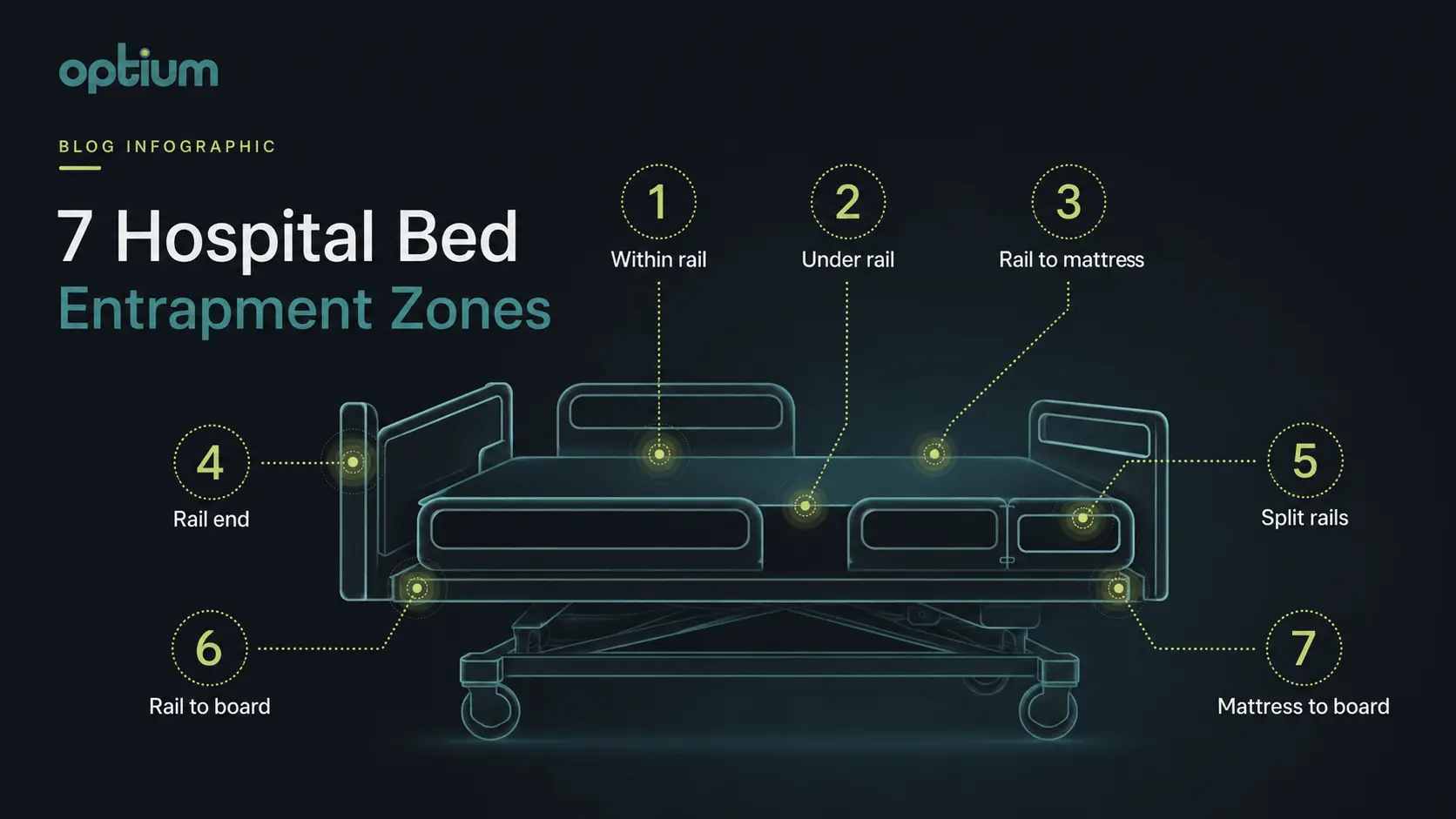
A bed with a solid rail panel may not have a meaningful Zone 1 opening. A bed without split rails will not have Zone 5. The framework should be applied to the actual configuration being used rather than treated as a generic checklist disconnected from the equipment.
Zone 1: Within the Rail
Zone 1 is any opening inside the perimeter of the side rail.
This may be a space between horizontal bars, vertical sections, handles, moulded plastic structures or other rail components.
The primary concern is that a patient’s head may enter the opening and become trapped.
FDA and Health Canada guidance use a head breadth reference of 120 millimetres, approximately 4.75 inches, when assessing this zone. The opening should not allow the specified test tool to enter or pass through under the defined testing conditions.
This does not mean staff should walk around the ward with a ruler and assume that a measurement below 120 millimetres proves the rail is safe.
Official assessment involves a shaped test tool, specified force and defined bed conditions. The rail must also be checked for looseness, damage and deformation.
Zone 1 can change when:
A rail bar bends
A fixing point loosens
A plastic panel cracks
A cover or insert is removed
An unofficial repair changes the opening
The rail is replaced with a different model
Solid or substantially enclosed rail designs may reduce large internal openings, but the complete rail still needs assessment for other zones, latching reliability, finger trapping and safe operation.
Zone 2: Under the Rail Between Its Supports
Zone 2 is the opening beneath the rail at a location between rail supports or beside a single support.
The mattress is important in this zone because the patient’s head can compress the mattress and enlarge the available space beneath the rail.
A gap that appears small while the mattress is empty may behave differently when weight is applied.
The risk can also change when:
The mattress becomes softer with age
The mattress shifts sideways
The rail develops movement
The bed platform raises or lowers
The rail is placed at an intermediate height
An overlay changes the effective mattress height
The patient repeatedly presses into the mattress edge
FDA and Health Canada guidance use a head related dimensional reference of less than 120 millimetres for this area.
However, mattress compression is not constant. A deep foam surface, powered air mattress or worn edge may compress differently from the original mattress used when the bed was tested.
This is why the mattress cannot be treated as a replaceable soft object with no effect on bed safety.
Zone 3: Between the Rail and Mattress
Zone 3 is the horizontal space between the inside of the rail and the side of the mattress.
This is the gap most people imagine when they hear the term bed rail entrapment.
The danger is that the head can enter the space between the rail and mattress while the body remains on the support surface.
Several factors can enlarge the gap:
A mattress that is too narrow
Lateral mattress movement
Soft mattress edges
A compressed or damaged mattress
Missing mattress retainers
A rail that has become loose
The wrong mattress placed on the bed
A mattress overlay that changes the surface profile
The specified mattress width alone does not prove compatibility.
A mattress may have the correct nominal width but still create risk because of its edge construction, compressibility, fixation method, cover tension or interaction with the bed platform.
FDA guidance recommends assessing the compressed mattress rather than relying only on the unoccupied gap.
Hospitals choosing a new support surface should therefore review length, width, thickness, edge behaviour, securing method and side rail geometry together. Optium’s guide to choosing a hospital mattress for pressure injury prevention explains why pressure performance and bed compatibility need to be evaluated as one decision.
Zone 4: Under the Rail at Its End
Zone 4 is the space between the compressed mattress and the lowest part of the rail near the rail’s open end.
This zone is especially important because it can create a wedge shaped opening.
The patient’s head may move beneath the rail while the neck becomes caught at the narrowing end. The person’s body weight and movement can then pull the neck farther into the opening.
For this zone, risk is not defined by distance alone.
The size and angle of the opening both matter.
FDA and Health Canada guidance use a neck related reference of less than 60 millimetres, approximately 2.38 inches, together with consideration of the angle of the V shaped opening.
The space can change when:
The backrest rises
The thigh section moves
The rail changes position
The mattress compresses
The patient slides toward the foot end
The rail or mattress shifts laterally
Patient migration is particularly relevant here. A patient who repeatedly moves down the bed may approach the open rail end or another changing gap. Optium’s guide to why patients slide down in hospital beds explains how gravity, mattress interaction and bed articulation create that movement.
Why Are Zones 1 to 4 Treated as the Highest Priority?
The FDA reports that Zones 1, 2, 3 and 4 accounted for approximately 80 percent of the entrapment reports reviewed by the Hospital Bed Safety Workgroup.
This is why the FDA developed detailed measurement methods and dimensional recommendations for these four zones.
That does not make Zones 5, 6 and 7 unimportant.
It means hospitals with limited time and resources should make sure the most frequently reported areas are not overlooked while still assessing the complete bed.
The official FDA guide for modifying bed systems also warns that any corrective action or accessory should not create another risk for the patient or healthcare worker.
Closing one gap is not a successful intervention if it creates a new gap somewhere else.
Zone 5: Between Split Rails
Many medical beds use separate head end and foot end rails instead of one continuous rail.
Zone 5 is the space between those split rails.
This space may allow a patient to attempt or accidentally begin leaving the bed. The neck or chest can become trapped between the two rail sections, especially if the opening forms a narrowing V shape.
The gap may be affected by:
Rail length
The distance between rail sections
Bed platform articulation
Whether one rail is raised and the other lowered
The position of the patient
Bed extension settings
The mattress length and position
Split rails can offer important benefits. They may improve patient access, allow a lower foot section for exiting and provide flexible protection near the upper body.
Their flexibility also creates more possible configurations.
The bed should therefore be evaluated in all rail positions that staff are expected to use, not only with every rail fully raised.
Zone 6: Between the Rail End and a Bed Board
Zone 6 is the space between the end of the side rail and the side edge of the headboard or footboard.
The neck, chest, arm or another part of the body may enter this opening.
The space may also form a wedge, particularly if the rail and board sit at different angles.
Zone 6 can change when:
The head or foot section rises
A removable bed board is not seated correctly
A rail is replaced
The bed is extended
A board develops movement
An accessory is installed beside the opening
Different rail combinations are used
A gap that is safe in the flat position may become less safe after articulation.
This is one reason product demonstrations should include movement through realistic care positions. A bed should not be approved solely by looking at it while flat and unoccupied.
Zone 7: Between the Mattress End and a Bed Board
Zone 7 is the space between the end of the mattress and the inner surface of the headboard or footboard.
This area may create a head entrapment risk when the mattress is too short, shifts along the platform or compresses away from the board.
The gap may appear after:
A replacement mattress is installed
The bed extension is opened
The extension filler is missing
The mattress retainer is damaged
A mattress gradually moves toward one end
The wrong mattress length is used
The headboard or footboard becomes loose
Bed extensions require particular attention.
Increasing the length of the platform without installing the manufacturer’s compatible mattress extension can create space that did not exist in the standard configuration.
A pillow, blanket or improvised foam piece is not automatically a safe substitute for the specified extension component.
Soft objects may compress, move or conceal the gap without controlling it.
Are the FDA Seven Zones Still Current in 2026?
The seven zone model remains a useful clinical and operational framework for explaining where entrapment can occur.
However, standards have continued to evolve.
In May 2026, the International Electrotechnical Commission published IEC 80601 2 52:2026, the new international standard covering the basic safety and essential performance of adult medical beds.
It replaces IEC 60601 2 52:2009 and its 2015 amendment at the international level.
The new standard applies to both electrical and manual medical beds intended for adults. This broader scope is important because entrapment risk is not created by motors alone. A manually adjusted bed can also contain unsafe openings, moving components or incompatible accessories.
For children and adults whose anatomy falls outside the adult definition, IEC 80601 2 89:2025 provides the separate international framework for medical beds intended for children and adults with atypical anatomy.
Publication of a new international standard does not mean every country applies it in exactly the same way or on the same date.
Regulatory transition periods, regional adoption, existing certifications and procurement requirements vary. Hospitals should confirm which standard, edition and national adoption apply to their project.
A supplier saying that a bed is “IEC compliant” is not enough.
The buyer should ask:
Which exact standard number?
Which edition and publication year?
Which bed configuration was tested?
Which mattress was used?
Which rails and accessories were included?
Which accredited laboratory issued the report?
Does the report cover the model being offered?
Why Are Smaller Patients at Greater Risk?
An opening designed around typical adult body dimensions may still be unsafe for a child or an adult with a smaller body.
The MHRA has identified children and adults with atypical anatomy as a priority group. Its 2023 alert referenced people with a physical size below 146 centimetres, body mass below 40 kilograms or body mass index below 17 when discussing the previous UK standard framework.
The new international children’s bed standard now covers children and adults outside the adult anatomy definition used by the new adult bed standard.
This distinction is critical.
A hospital should not assume that a standard adult bed is safe for a small patient simply because the patient can physically lie on it.
Smaller heads, necks and chests may enter openings that would not admit the corresponding body part of a typical adult.
A documented clinical reason and additional risk controls may be needed when the ideal bed is not available.
Who Else Faces Greater Entrapment Risk?
Entrapment risk is shaped by the patient’s body, movement, cognition and ability to escape.
Greater attention may be required for people with:
Confusion, delirium or dementia
Reduced consciousness
Sedation
Seizures or involuntary movement
Repetitive movement
Limited mobility
Paralysis
Communication difficulties
Severe weakness
Unusual body dimensions
Significant weight loss
Agitation
Reduced ability to recognise danger
An existing history of climbing over rails
Medical tubing or devices that restrict movement
A patient’s risk can change during the same admission.
Someone alert and independently mobile on the first day may later receive sedating medication, become weaker or develop delirium. A patient may lose weight during a prolonged stay. A new stroke or neurological change may affect movement.
Risk assessment must therefore be repeated when the patient’s condition changes.
The physical decline associated with immobility may also reduce a patient’s ability to escape from an unsafe position. Optium’s article on the effects of prolonged hospital bed rest explains how strength, balance and mobility can deteriorate during hospitalisation.
Why Must the Bed and Mattress Be Treated as One System?
A bed frame can pass its original tests and still become unsafe after the support surface is replaced.
The mattress affects:
The gap beside the rail
The space beneath the rail
The height of the rail above the patient surface
The patient’s position relative to the rail
The way the surface compresses under the head or chest
The behaviour of the bed during articulation
The effectiveness of mattress retainers
The space at the head and foot ends
Length, width and thickness are only the beginning.
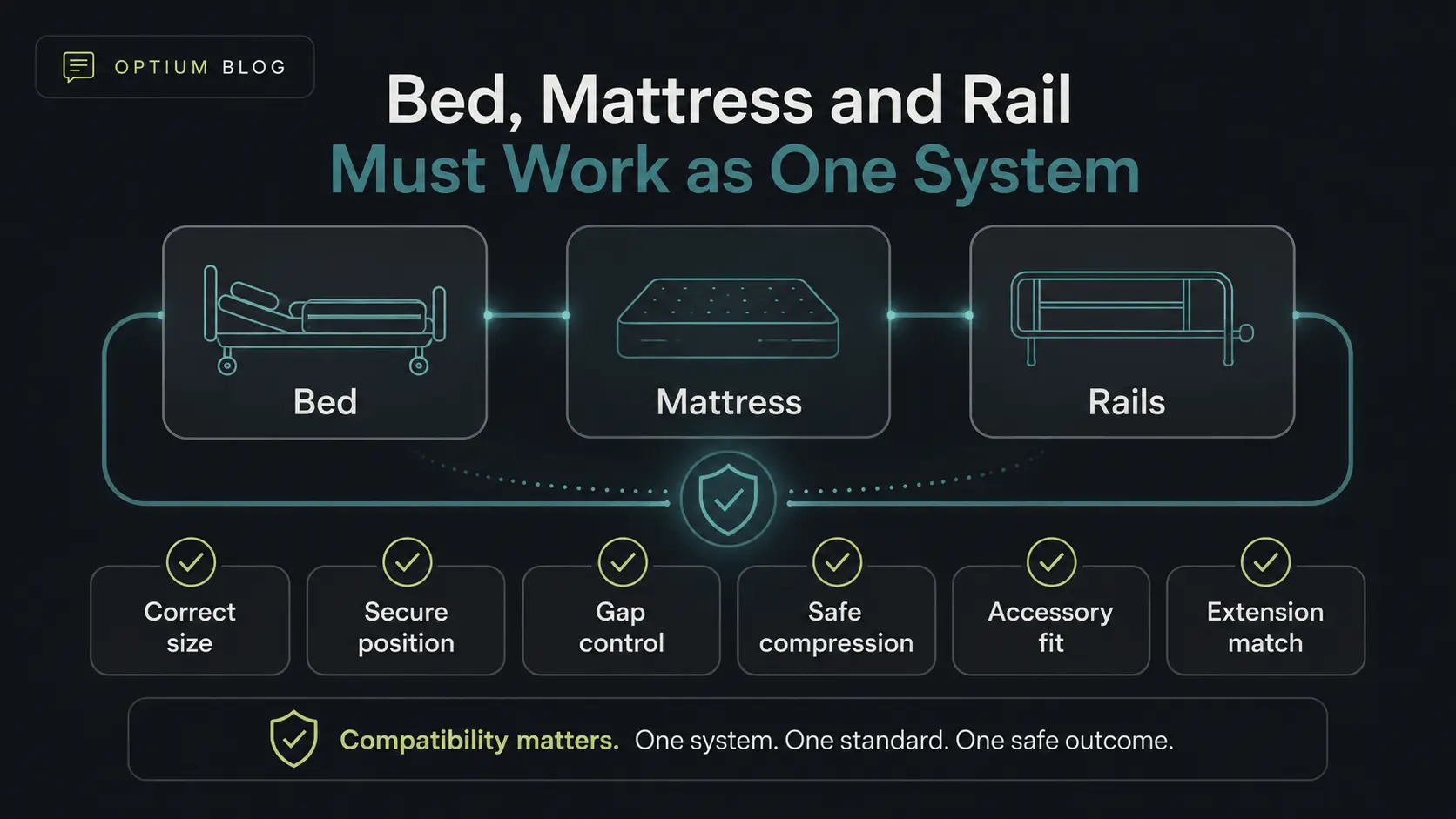
Two mattresses with the same listed dimensions can behave differently because of:
Foam density
Edge reinforcement
Air cell construction
Cover tension
Age and wear
Patient weight
Inflation setting
Lateral movement
Fixation method
A very thick mattress may reduce the effective height of the rail above the surface. A narrow mattress may increase the lateral gap. A soft edge may enlarge the opening under load.
The safest practice is to use mattresses and overlays specifically approved by the bed manufacturer or supported by a documented compatibility assessment.
Can a Pressure Relief Mattress Create New Gaps?
Yes.
A pressure relief mattress may be clinically beneficial while also changing bed system geometry.
Powered air systems, alternating surfaces, low air loss mattresses, overlays and deeply immersive surfaces can compress differently from a standard foam mattress.
Potential changes include:
Lower effective rail height
Greater edge compression
Increased space between the rail and mattress
Movement of the mattress on the platform
Different behaviour during bed articulation
Added hoses or equipment near the rail
Changed patient height relative to rail controls
This does not mean pressure relief mattresses should be avoided.
It means their clinical benefit must be balanced with complete compatibility testing.
No pressure surface should be approved independently from the bed on which it will be used.
Optium’s FM 01 foam mattress, for example, has listed dimensions and construction features relevant to compatibility assessment. Those specifications do not independently prove that it is suitable for every bed frame or rail configuration.
The complete combination must be reviewed.
Can Bed Movement Change an Entrapment Gap?
Yes.
A medical bed is dynamic equipment.
The backrest rises. The thigh section changes angle. The platform moves into Trendelenburg or reverse Trendelenburg. The bed height changes. Rails may rotate, fold or move relative to the mattress platform.
A gap can:
Become larger
Become smaller
Change shape
Become accessible to the patient
Become inaccessible
Appear only at a certain angle
Move closer to the patient’s head or chest
Testing only the flat position can miss the most dangerous configuration.
The FDA and Health Canada guidance specifically recognise that some spaces change as the bed articulates.
Facilities should review positions used in the intended department, including:
Flat
Common backrest angles
Fowler position
Auto contour
Trendelenburg positions
Bed exit position
Maximum and minimum height
All permitted rail positions
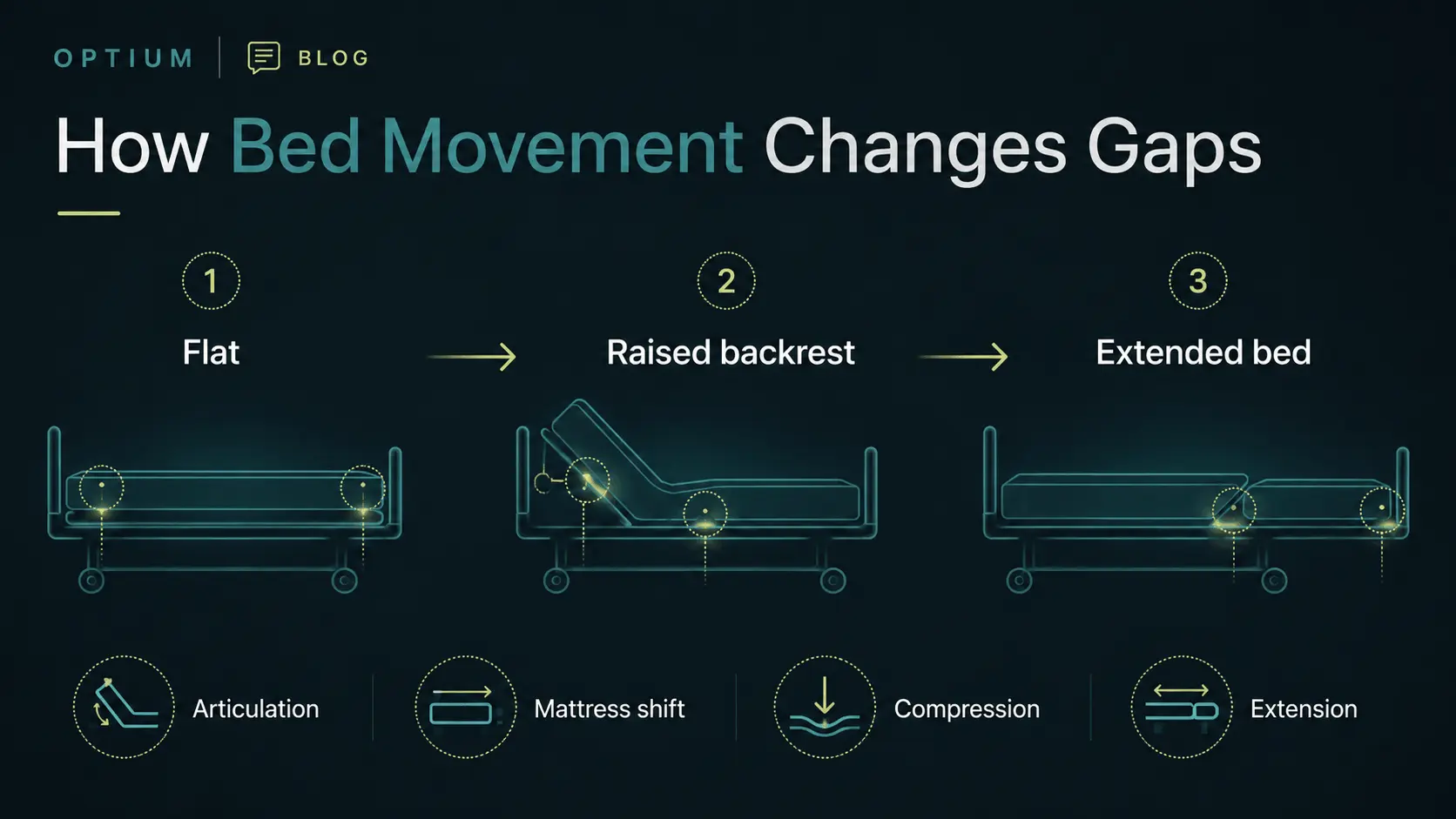
Hospitals comparing different control and positioning configurations can review Optium’s guide to three motor and four motor hospital beds.
Additional movement does not automatically make a bed less safe, but it creates more configurations that must be considered.
Do Accessories Affect Entrapment Risk?
They can.
An accessory may close an existing opening, create a new opening or change the way a patient approaches part of the bed.
Relevant accessories include:
Mattress overlays
Rail covers
Gap fillers
Bed extension components
Lateral turning systems
Positioning poles
Bed handles
IV poles
Drainage holders
Oxygen holders
Patient control holders
Transfer aids
Additional cushions
Bumpers
Accessories should be assessed in every position in which they will be used.
A rail cover may reduce openings inside the rail but affect visibility, cleaning, release mechanisms or the patient’s ability to grip the rail. A bumper may close one space while creating another at its end.
FDA guidance states that mitigation measures should not increase the risk of another injury to the patient or healthcare worker.
Improvised accessories are particularly difficult to evaluate because the original bed manufacturer may never have tested them.
Can Maintenance Turn a Safe Bed Into an Unsafe Bed?
Poor maintenance can change the geometry of a bed.
A small amount of movement in one component may create a much larger opening once the rail, mattress and patient weight interact.
Warning signs include:
Loose rail supports
Rails that move after locking
Worn latches
Damaged plastic panels
Bent metal components
Missing fasteners
Cracked mattress retainers
Loose headboards or footboards
Uneven rail movement
Rails that do not remain in the selected position
Damaged bed extensions
Mattress platforms that do not align correctly
Unofficial repairs or replacement parts
The MHRA reports that incident investigations have identified missing maintenance, worn parts, incompatible accessories and outdated risk assessments as contributing factors.
Preventive maintenance should not focus only on motors, batteries and castors.
The integrity, movement and latching of every patient protection component must also be checked.
Can Cleaning or Mattress Replacement Change the Risk?
Yes.
Cleaning and maintenance often require components to be removed and reinstalled.
A mattress may be returned in the opposite orientation. A headboard may not be fully seated. A removable rail may be fitted incorrectly. A mattress retainer may be left unlocked.
A complete room turnover should include a visual confirmation that:
The correct mattress is present
The mattress is centred
Retainers are engaged
Boards are secure
Rails move correctly
Rail locks engage
No accessory creates a new opening
The bed extension matches the mattress configuration
The areas around rails, mattress edges and removable platforms are also among the surfaces that require environmental cleaning. Optium’s guide to high touch areas around a hospital bed explains why cleaning access and correct reassembly should form part of the same workflow.
Are Portable Home Bed Rails the Same as Hospital Bed Rails?
No.
A portable bed assist rail added to a domestic bed is not the same product as an integral side rail designed and tested as part of a medical bed.
Portable rails may depend on straps, mattress weight or the domestic bed structure to remain in place. Compatibility can vary significantly between mattress and frame combinations.
The FDA seven zone framework can help explain the general risk, but the applicable product rules and test standards may differ.
Hospitals should not use consumer portable rail recalls as direct evidence that an integrated medical bed rail is unsafe.
The shared lesson is narrower:
A rail cannot be evaluated separately from the bed and mattress to which it is attached.
Is Measuring the Gap With a Tape Measure Enough?
No.
A basic visual check can identify obvious problems, but formal dimensional assessment requires defined test methods.
The official methods may involve:
A shaped test cone
Specified force
Mattress compression
Defined rail positions
Multiple bed angles
Worst case component configurations
Repeat testing across every rail
Documented interpretation criteria
A simple linear measurement may miss:
A V shaped wedge
Mattress compression
A changing articulation gap
A gap that admits the head but traps the neck
Movement in a loose rail
An opening accessible only from a particular direction
The MHRA specifically warns that dimensional values in product standards are primarily intended for manufacturers and should not be used uncritically as the sole clinical safety assessment.
Hospitals that need formal testing should use trained personnel, the correct tools and the relevant current procedure.
A Practical Bedside Visual Check
The following visual check is not a substitute for formal testing or clinical assessment. It can help staff recognise when the bed should be removed from use or referred for further inspection.
Before or during use, ask:
Is this the mattress specified for this bed?
Is the mattress centred and secured by its retainers?
Are there visible spaces beside or beneath the rails?
Do the rails lock firmly without excessive movement?
Do the gaps change significantly when the bed moves?
Are the headboard and footboard fully secured?
Is a bed extension open without the matching mattress section?
Has an overlay or accessory changed the effective mattress height?
Is the patient unusually small, confused, sedated or unable to reposition?
Has the patient’s condition, weight or mobility changed?
Are there damaged, bent, loose or unofficially repaired components?
Could the patient climb over the rail rather than benefit from it?
An unexpected answer should trigger the facility’s escalation procedure rather than an improvised repair.
What Should Biomedical Engineering Test?
Biomedical teams need a repeatable process that connects technical inspection with the actual clinical configuration.
The programme may include:
Bed identification by make, model and serial number
Applicable standard and edition
Approved rail models
Approved mattress dimensions and types
Compatible overlays and accessories
Rail locking reliability
Rail movement and play
Bed board security
Mattress retainer integrity
Bed extension function
Gap assessment in defined positions
Inspection after repair or part replacement
Documentation of failed configurations
Removal from service criteria
Corrective action and retesting
Training and competency records
Legacy beds deserve particular attention because parts may have been replaced during years of service.
A bed frame from one manufacturer, rail from another and mattress from a third may look functional while having no documented evidence that the combination is safe.
What Should Procurement Teams Request Before Buying?
A product brochure may say:
Safe gap
Reduced entrapment
Full mattress coverage
Anti entrapment rail
Minimum gap design
Compliant side rails
These phrases need evidence.
Procurement teams should ask:
Which medical bed standard and edition does the model meet?
Has the model been evaluated against IEC 80601 2 52:2026?
Which regional certifications or transition rules currently apply?
Which mattress was used during testing?
Which rail, bed board and extension configurations were tested?
Does the test cover every rail position?
Does the test cover articulated bed positions?
Are specialty mattresses or overlays approved?
What are the permitted mattress length, width, thickness and edge characteristics?
Are test reports available from an accredited laboratory?
Are the reports specific to the exact model being supplied?
Which parts require routine measurement or inspection?
What rail movement or latch wear is considered unacceptable?
Are replacement rails and boards traceable to the bed model?
What happens to compatibility when the bed is extended?
Are gap fillers supplied for extension configurations?
Is a separate configuration required for smaller adults?
Are pediatric or atypical anatomy beds available?
What staff training is provided?
How are safety updates and field notices communicated?
These questions should be added to the wider electrical, hygiene, mobility and service review described in Optium’s hospital bed buying checklist.
Is Standards Compliance Enough?
No.
Standards compliance is essential evidence about the equipment design and testing. It does not replace clinical assessment.
A compliant adult bed may still be inappropriate for:
A child
A very small adult
A confused patient who will climb over the rails
A patient requiring an incompatible specialty surface
A patient whose involuntary movements create unusual risk
A configuration modified with unapproved accessories
Clinical assessment is also not a substitute for compliant equipment.
A detailed nursing care plan cannot make a damaged rail or incompatible mattress mechanically safe.
The strongest system combines:
Suitable equipment
Current conformity evidence
Patient specific assessment
Correct mattress selection
Trained staff
Preventive maintenance
Documented inspections
Clear incident reporting
Regular reassessment
How Do Optium Bed Features Relate to Entrapment Assessment?
Optium hospital beds use different rail, platform and positioning configurations across product families.
The CL 32 electronic patient care bed, for example, includes fold away polypropylene side rails, removable head and foot boards, an ABS mattress platform, auto contour and backrest auto regression.
Higher acuity models such as the CL 50 electronic ICU bed add integrated rail controls, lateral tilt, advanced positioning, a bed extension option and additional accessories.
These are relevant features for a bed system assessment.
Their presence does not independently prove that every mattress, extension, rail position or accessory combination is free from entrapment risk.
Hospitals considering an Optium model should request:
The applicable conformity documents
The exact mattress specifications
Rail and board compatibility information
Bed extension instructions
Approved accessories
Inspection and maintenance criteria
Configuration specific test evidence
The same standard should be applied to every manufacturer.
A feature list explains what equipment contains.
A test report explains what configuration was evaluated.
A clinical assessment explains whether that configuration is appropriate for the patient.
Can a More Expensive Bed Still Create Entrapment Risk?
Yes.
Price is not proof of compatibility.
A premium ICU bed may contain more rails, controls, movement functions, extensions and accessories than a standard ward bed. These features may improve care while creating more configurations that require assessment.
A lower cost bed may have simpler geometry but fewer safeguards, less documentation or limited mattress compatibility.
The correct comparison is not:
Which bed costs more?
It is: Which complete bed system has appropriate evidence for the intended patients, mattresses, positions and clinical environment?
Optium’s hospital bed price comparison explains why purchase price must be considered alongside construction, safety, maintenance, service and lifecycle value.
What Can Good Bed Design Reduce?
A well designed and correctly configured system may help reduce risk through:
Smaller controlled openings
Solid or carefully shaped rail panels
Secure rail latching
Reduced movement between components
Compatible mattress retainers
Controlled split rail spacing
Suitable board and rail relationships
Correct extension fillers
Clear mattress specifications
Protected articulation points
Documented accessory compatibility
Easier inspection and maintenance
These design choices matter.
What Can Bed Design Not Guarantee?
No bed can guarantee safety in every configuration and for every patient.
Design cannot replace:
Individual assessment
Correct mattress selection
Appropriate rail use
Staff observation
Maintenance
Reassessment after clinical change
Correct use of extensions
Approved accessories
Incident reporting
A suitable pediatric or atypical anatomy bed
The objective is not to claim that entrapment is impossible.
The objective is to reduce foreseeable risk, detect unsafe configurations and prevent staff from assuming that a familiar looking bed is automatically safe.
The Most Dangerous Gap May Be the One Created Later
A new bed leaves the manufacturer in a defined configuration.
Years later, the system may include a replacement mattress, repaired rail, new overlay, added accessory and different headboard.
Each component may look acceptable on its own.
The danger appears in the relationship between them.
That is why entrapment prevention should not be owned by only one department.
Procurement chooses the system.
Biomedical engineering maintains it.
Nursing assesses the patient.
Environmental services may remove and reinstall components.
Infection prevention influences mattress and cleaning choices.
Risk management investigates incidents.
A safe bed system depends on those decisions remaining connected throughout the equipment’s life.
Hospitals planning a new ward, replacing legacy beds or reviewing mattress compatibility can contact Optium Healthcare to discuss bed configurations, rail systems, mattress dimensions, extensions and technical documentation for the intended department.
Frequently Asked Questions
What are the seven hospital bed entrapment zones?
The seven zones are within the rail, beneath the rail between supports, between the rail and mattress, beneath the rail at its end, between split rails, between the rail end and a headboard or footboard, and between the mattress end and a headboard or footboard.
Which entrapment zones are considered the highest priority?
FDA guidance prioritises Zones 1 to 4 because they accounted for approximately 80 percent of the entrapment reports reviewed by the Hospital Bed Safety Workgroup.
What gap is considered safe between a hospital mattress and rail?
There is no universal tape measure answer for every configuration. FDA and Health Canada guidance use a 120 millimetre head related reference for several zones, but formal testing requires specified tools, force, mattress compression and bed positions.
Why is Zone 4 especially dangerous?
Zone 4 can create a narrowing opening beneath the end of the rail. The head may enter while the neck becomes wedged in the smaller space. Both the size and shape of the opening matter.
Can the wrong mattress cause bed entrapment?
Yes. A mattress that is too narrow, short, thick, soft or incompatible can change the gaps beside and beneath the rail, reduce effective rail height or create space near the headboard and footboard.
Can a pressure relief mattress increase entrapment risk?
It can change the risk if it compresses, moves or raises the patient differently from the mattress approved for the bed. Clinical benefit and bed compatibility must be assessed together.
Do all hospital beds have seven entrapment zones?
No. The seven zones describe potential locations. Some zones may not exist on a particular bed because of its rail and board design.
Are bed rails always safer for confused patients?
No. A confused or agitated patient may try to climb over a rail, increasing fall height. Rail use must be based on an individual assessment of benefits and risks.
Should hospital staff measure rail gaps themselves?
Staff should report obvious problems, but formal dimensional testing should be performed by trained personnel using the correct tools and procedures. A tape measure alone cannot assess all entrapment mechanisms.
What is the current international standard for adult medical beds?
IEC 80601 2 52:2026 is the current international standard covering the basic safety and essential performance of adult medical beds. It was published in May 2026 and replaces the previous IEC 60601 2 52 standard at the international level.
Which standard applies to pediatric beds and smaller patients?
IEC 80601 2 89:2025 covers medical beds intended for children and adults whose anatomy falls outside the adult definition used by the adult bed standard.
Does an IEC compliant bed eliminate the need for patient assessment?
No. Standards compliance addresses equipment design and testing. Clinical teams must still assess whether the bed, mattress and rail configuration are appropriate for the individual patient.
Sources and Methodology
This article was developed using the FDA Hospital Bed System Dimensional and Assessment Guidance, the FDA guide for modifying bed systems and using accessories, the Health Canada adult hospital bed guidance and current MHRA guidance on bed rail management and safe use.
The standards section reflects the publication of IEC 80601 2 52:2026 for adult medical beds and IEC 80601 2 89:2025 for medical beds intended for children and adults with atypical anatomy.
Public product and technical documentation from major hospital bed manufacturers was reviewed to understand how the market describes minimum gaps, rail coverage, mattress compatibility and anti entrapment features. Manufacturer claims were treated as product information rather than independent clinical evidence.
The seven zone model originated before the latest IEC standard and remains useful as a communication and risk assessment framework. Hospitals must confirm which standards, regional adoptions and regulatory transition rules apply to their procurement project.
This content is intended for healthcare education, equipment planning and general risk awareness. It does not replace formal device testing, local regulation, manufacturer instructions, clinical assessment or advice from qualified medical device safety professionals.