


A patient leaves the room. The used sheets are removed, fresh linen is fitted and the bed looks ready for the next person.
But is the hospital bed actually clean?
The answer depends on much more than the linen.
During a single care episode, patients, nurses, physicians, visitors, porters and cleaning teams may touch the same bed rails, control panels, handles and nearby furniture. Some contact points are easy to see. Others sit underneath the mattress, behind a control panel or close to the floor, where they are easier to overlook.
This does not mean every hospital bed is dangerous or that touching one will cause an infection. Environmental contamination is only one part of a much larger transmission chain. It does mean that hospital bed cleaning should be treated as a defined healthcare process rather than a cosmetic task.
For facilities comparing hospital beds and medical equipment, cleanability should be considered alongside positioning, mobility, patient safety, maintenance and clinical suitability.
The most useful question is not simply:
Was the bed wiped?
The better question is: Were the correct surfaces cleaned and disinfected with the correct product, process, contact time and frequency?
Quick Answer: How Long Can Germs Survive on a Hospital Bed?
There is no single survival time. Persistence depends on the organism, surface material, moisture, temperature, organic contamination and cleaning conditions. Some organisms remain for relatively short periods, while Candida auris may survive for weeks and Clostridioides difficile spores can remain on surfaces for months or years.
Finding an organism on a surface does not automatically mean that an infection will occur. Transmission also requires an opportunity for that organism to move from the contaminated surface to a susceptible person.
However, surfaces touched repeatedly by patients, healthcare workers and visitors create more opportunities for transfer. That is why frequently handled parts of the bed and surrounding patient zone require particular attention.
Is a Hospital Bed Clean Once the Sheets Are Changed?
Not necessarily.
Bed linen covers only part of the patient environment. The rails, patient handset, control panels, headboard, footboard, mattress cover, mattress platform, frame and brake controls remain in place after the sheets are removed.
Nearby furniture also remains part of the same contact environment. The overbed table, bedside cabinet, IV pole and adjustment handles may be used by several people during the same shift.
The Centers for Disease Control and Prevention guidance on environmental cleaning identifies bed rails, bed frames, IV poles, bedside tables, tray tables and handles among common high touch surfaces in healthcare areas.
Changing the linen is therefore an important task, but it is not the same as cleaning and disinfecting the complete bed.
A clean looking surface may still require attention. The opposite is also true. A visible mark does not reveal which microorganisms are present. Environmental cleanliness cannot be judged reliably by appearance alone.
Why Do High Touch Surfaces Require More Attention?
A wall and a bed rail can exist in the same room, but they do not have the same contact pattern.
The bed rail may be touched when the patient changes position, when a nurse provides care, when a relative helps the patient sit up and when the cleaning team prepares the room. A wall may go untouched for most of the day.
The number of contacts matters because each interaction creates another opportunity for microorganisms to move between hands, gloves, equipment and surfaces.
CDC guidance recommends that high touch surfaces receive more frequent and rigorous attention than low touch surfaces. Cleaning frequency should also reflect the vulnerability of the patient, the likelihood of contamination and the type of care provided in the area.
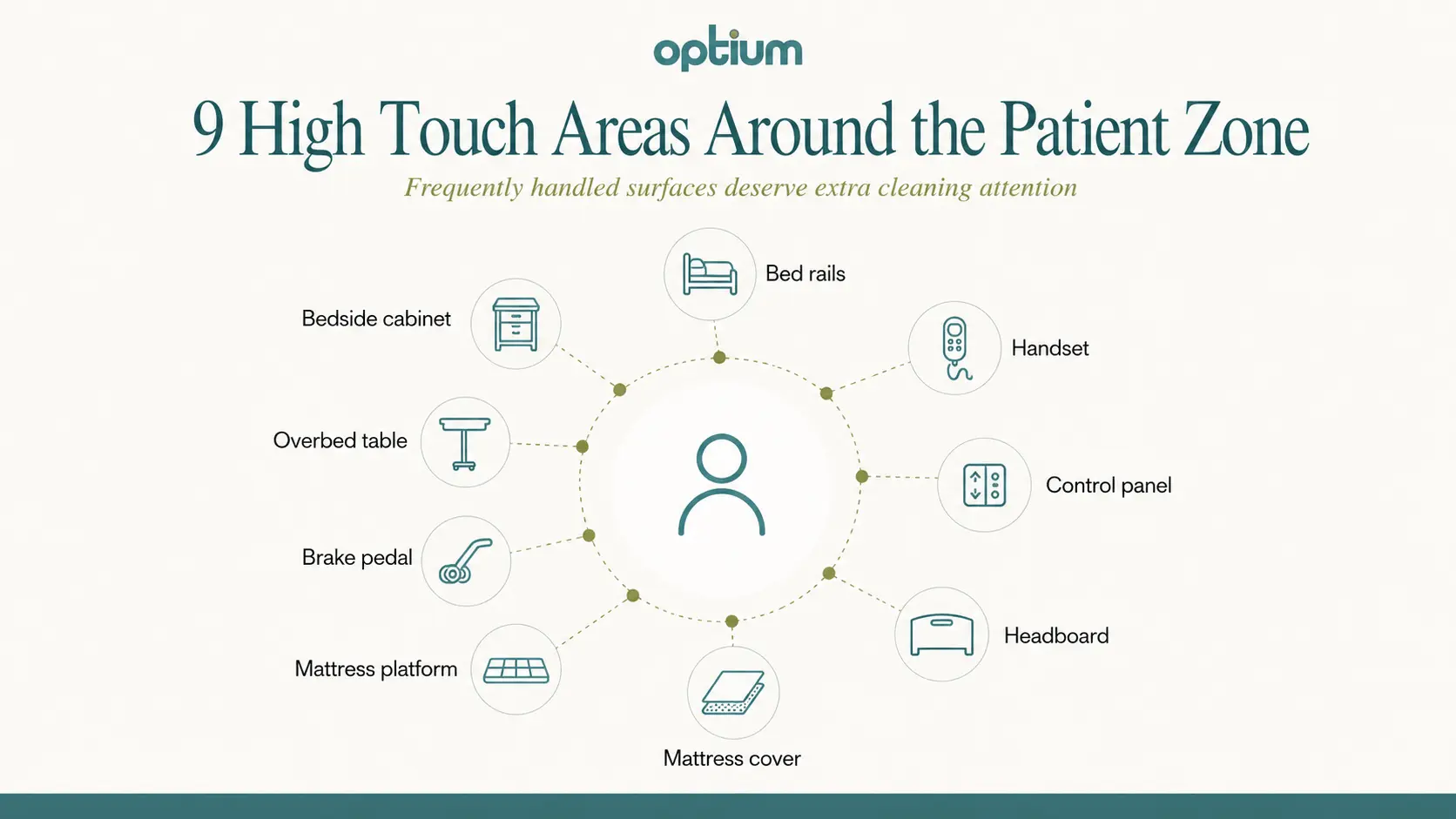
High touch is not a permanent label that applies equally in every department. Each healthcare facility should identify the surfaces that are repeatedly handled within its own clinical workflow.
A general ward, isolation room, intensive care unit and postoperative recovery area may therefore have different priorities.
How Long Do Organisms Survive on Hospital Surfaces?
The word germs includes organisms with very different properties.
A bacterium that produces resistant spores does not behave like an enveloped virus. A dry stainless steel rail does not create the same conditions as a damaged or wet mattress cover. Temperature, humidity, bodily fluids, surface material and cleaning agents can all influence persistence.
This is why a responsible article should not claim that every organism survives for a fixed number of hours or days.
Two examples demonstrate how different the answer can be.
Candida auris
The CDC reports that Candida auris can survive on surfaces for weeks. It can spread within healthcare environments and is not reliably inactivated by every commonly used disinfectant.
Facilities caring for patients affected by Candida auris need daily and terminal cleaning procedures that use products appropriate for the organism. Current recommendations are available in the CDC guidance for Candida auris infection control.
Clostridioides difficile
Outside the body, Clostridioides difficile can form spores with a protective coating. These spores are more resistant than many common organisms and may remain in the environment for months or years.
The CDC overview of Clostridioides difficile explains why contaminated surfaces, equipment and materials can become reservoirs when the correct cleaning and disinfection process is not followed.
These examples are not reasons for patients or visitors to panic. They show why hospitals should not assume that one generic wiping process will be suitable for every organism and every patient room.
1. Why Are Bed Rails Among the Most Important Surfaces?
Bed rails are among the clearest examples of high touch hospital surfaces.
Patients may grip them while changing position, sitting up or preparing to stand. Nurses may raise and lower them while providing care. Relatives may place their hands on them while talking to the patient.
The same rail can therefore sit directly within the movement path between hands, gloves, equipment and the patient.
Bed rails also play a role in mobility and transfer safety. Optium’s guide to patient falls and hospital bed safety explains why rail use, bed height, braking and individual patient assessment must be considered together.
Cleaning becomes more difficult when a rail contains deep recesses, multiple joints, exposed fixing points, textured surfaces or narrow gaps.
A fold away rail may need to be cleaned in more than one position. The outer section can appear clean while the hinge, lower surface or locking mechanism remains inaccessible until the rail is moved.
For procurement teams, the question should not be limited to whether the bed includes side rails.
The more useful question is whether cleaning teams can reach every relevant rail surface without dismantling the bed, damaging components or creating an unrealistic room preparation process.
2. Are Patient Handsets and Control Panels Easy to Miss?
The patient handset may be one of the most frequently handled objects attached to a hospital bed.
Patients may use it after eating, coughing, touching personal belongings or using the bathroom. Nurses may handle the same device while positioning the patient or explaining bed functions.
Embedded nurse controls and rail mounted buttons create similar concerns. These components often contain symbols, edges, buttons, cable connections and small gaps that may require more careful wiping than a flat surface.
Cleaning these controls involves more than wiping the centre of the device.
Hospitals need clear answers to several practical questions. Can the handset tolerate the facility’s approved cleaning product? Can liquid enter around the buttons or cable connection? Does the manufacturer specify protection against moisture? Who is responsible for cleaning the control during routine care and after discharge?
A control device may be technically cleanable but still become a workflow gap when no team clearly owns the task.
The product instructions and facility procedure should explain whether the device can be wiped, sprayed indirectly or cleaned only with a lightly dampened cloth. Electrical components should never be saturated unless the manufacturer specifically permits it.
Controls also become more complex as hospital beds add functions. Facilities comparing standard and advanced configurations can review Optium’s explanation of three motor and four motor hospital beds to understand how motor count, positioning and control systems affect daily use.
3. What Makes Headboards and Footboards Important?
Headboards and footboards may be touched during transport, repositioning, bed making, maintenance and room preparation.
They are sometimes treated as structural components rather than patient zone surfaces. In practice, staff may hold them while moving the bed, and personal or clinical items may temporarily come into contact with them.
Detachable components can make the mattress platform and frame easier to access, but only when removal is practical.
The cleaning team should be able to determine whether the board detaches without tools, whether every side can be reached and whether the locking mechanism creates a hidden recess.
A detachable board should not automatically be described as preventing infection. It is a design feature that may support easier access when combined with an appropriate cleaning process.
The CL 32 Electronic Patient Care Bed, for example, includes detachable head and foot boards, fold away side rails and an easy removable ABS mattress platform.
Those details are relevant to a cleanability assessment, but they do not replace staff training, approved disinfectants, written procedures or inspection after cleaning.
Procurement teams comparing models across standard patient care wards can also review the wider Collesium hospital bed series before matching features with department requirements.
4. What Can Hide Around the Mattress Cover, Seams and Zipper?
The mattress may appear to be one simple surface, but it is a system of several layers.
The patient contacts the cover. Beneath it are the foam or therapeutic components. Around the edges may be seams, welded joints, a zipper, handles or areas where fluid can accumulate.
An intact, moisture resistant cover helps protect the inner mattress. Once the cover becomes torn, cracked, punctured, damaged or unable to remain sealed, cleaning the exterior may no longer protect the material underneath.
The CDC guidance on mattresses and bedding states that mattress covers should be maintained, cleaned with compatible products and replaced when damaged. A mattress that remains wet or visibly stained may need to be replaced rather than covered with fresh linen.
This makes mattress inspection part of cleaning rather than a separate maintenance activity.
Cleaning teams should pay attention to:
Damage near the zipper
Cracked or peeling coatings
Fluid entering seams
Staining beneath the cover
Moisture that does not dry as expected
Cleaning agent damage
Permanent compression that creates new folds
The strongest chemical is not automatically the safest choice. A product that gradually weakens the mattress cover can make future cleaning more difficult.
Hospitals evaluating support surfaces can use Optium’s guide to choosing a hospital mattress for pressure injury prevention to compare mattress type, patient risk, cover integrity and bed compatibility.
The FM 01 Foam Mattress can also be reviewed as an example of a hospital mattress supplied with a waterproof and breathable cover. Final suitability still depends on the patient population, clinical objective and approved cleaning process.
5. Is the Mattress Platform Cleaned as Carefully as the Mattress?
The mattress platform is normally hidden during patient care.
That makes it easy to forget.
When the mattress is removed, the platform may reveal dust, skin particles, fluid residue or contamination around joints and removable sections. Accessory sockets and frame intersections may also remain close to the patient zone without being visible during routine wiping.
A removable platform can improve access, but the design must still be evaluated in practice.
Can each section be lifted without specialist tools? Are there hollow channels or narrow recesses? Can fluid drain safely? Is there a clean location where removed sections can be placed during room preparation?
A platform should not be judged only by how smooth it appears in a product image. The underside, attachment system and connection to the bed frame matter as well.
This is particularly important in departments with frequent admissions and discharges. Cleaning teams may have limited time between patients, so access needs to be straightforward and repeatable.
Hospitals planning surgical wards can connect this cleanability assessment with the positioning and workflow factors explained in Optium’s guide to electric hospital beds for postoperative recovery.
The mattress platform should support both clinical use and realistic room preparation. A design that is technically removable but too difficult to handle during routine work may offer less practical value than the specification suggests.
6. Why Do Brake Pedals and Castors Matter?
Brake pedals and castors are far from the patient’s face, but they are used repeatedly during transport, transfers, cleaning and room preparation.
They are mainly touched by shoes, but staff may also use gloved hands while inspecting, unlocking or repositioning equipment. These components operate close to the floor, where dust, hair and fluid residue may accumulate.
Their position creates a different cleaning challenge from a patient handset or bed rail.
Castors include rotating surfaces, forks, axles and narrow spaces. Central braking systems may have pedals at the head or foot end. Protective covers can simplify the visible exterior while concealing mechanical areas underneath.
Hospitals should distinguish between external surfaces that cleaning staff can reach and internal mechanical components that maintenance teams must inspect.
Cleaning must not compromise braking performance, electrical safety or lubrication. Components should not be flooded or aggressively sprayed unless the manufacturer permits it.
These details are one reason a hospital bed should not be assessed by appearance or purchase price alone. Optium’s hospital bed price comparison explains how braking systems, mobility, cleanability, construction and maintenance contribute to long term value.
Procurement teams should request written cleaning and maintenance instructions rather than accepting a generic claim such as easy to clean.
7. Are IV Poles and Accessory Holders Part of the Bed Cleaning Zone?
In many patient rooms, they are.
IV poles may be handled during medication administration, transport, line management and bed repositioning. The pole itself is only one part of the contact surface.
Height adjustment collars, hooks, accessory sockets, oxygen holders, drainage bag hooks and monitor supports may also be touched during care.
Some accessories remain attached to the bed when the patient leaves. Others move between rooms or follow the patient to another department. That creates an important ownership question.
Does the environmental services team clean the accessory? Does nursing clean it? Is it treated as part of the bed, reusable medical equipment or a separate item?
A surface can appear in a written cleaning policy and still be missed when no team has clear responsibility for it.
Hospitals should define who cleans every attached and shared accessory during routine care, after transfer and after discharge.
The same principle applies when facilities compare different bed configurations. More functions and accessories can improve clinical capability, but every additional component also creates another surface that must be maintained and included in the cleaning procedure.
For facilities building a complete equipment specification, Optium’s hospital bed buying checklist includes questions covering accessories, electronics, cleaning, maintenance and department fit.
8. Is the Overbed Table Part of the Patient Environment?
The overbed table may be used for meals, medication cups, phones, books, clinical items and personal belongings, sometimes within the same day.
Patients touch the top and adjustment controls. Nurses, visitors and food service teams may reposition it. Phones, bags and care items may all be placed on the same surface.
For this reason, cleaning should include more than the top panel.
The table edge, height adjustment lever, column, underside, frame and castor controls may also be touched. A tilting or adjustable table creates additional joints and surfaces that need to remain accessible.
Material compatibility matters because repeated disinfection can affect plastics, laminates, adhesives, edge bands and coatings differently.
A smooth surface may support wiping, but buyers should still examine corners, seams and adjustment mechanisms.
Hospitals comparing different configurations can explore the full range of bedside cabinets and overbed tables before assessing the individual products against room size, cleaning access and patient use.
The OB 36 Overbed Table, for example, includes an ABS covered table surface, gas spring height adjustment and lockable castors.
These features can inform a cleanability review, but the complete unit and its mechanism still need to be included in the hospital’s procedure.
Room layout matters as well. A table that is difficult to move can obstruct access to the bed, wall or floor during cleaning. It can also interfere with patient transfers when positioned poorly.
9. What Do People Forget About the Bedside Cabinet?
A bedside cabinet can be touched by almost everyone entering the patient zone.
Patients use drawer pulls, cupboard doors and the top surface. Nurses may move personal belongings to reach clinical items. Visitors may open drawers or place phones and food on top. Cleaning teams may move the cabinet but overlook the rear panel, underside or internal corners.
Handles and drawer edges deserve particular attention because several fingers repeatedly contact a relatively small surface.
Cleaning may need to cover the top, containment edges, drawer handles, cupboard handles, internal surfaces when contaminated, side panels, bottle holders, towel holders, castors and areas normally hidden against the wall.
The cabinet’s function also affects contamination. A surface used for food and personal items should not casually become a storage point for used clinical equipment.
Optium’s article on how patient room furniture shapes recovery, comfort and satisfaction explains why cabinets and overbed tables should be treated as part of the complete care environment rather than decorative storage.
The CB 16 Complete ABS Bedside Cabinet provides an example of a mobile polymer cabinet with drawers, internal compartments, side holders and castors.
Each additional function adds value for patient use, but it may also add another contact point that must be considered within the cleaning process.
What Is the Difference Between Cleaning and Disinfection?
Cleaning and disinfection are related, but they are not exactly the same task.
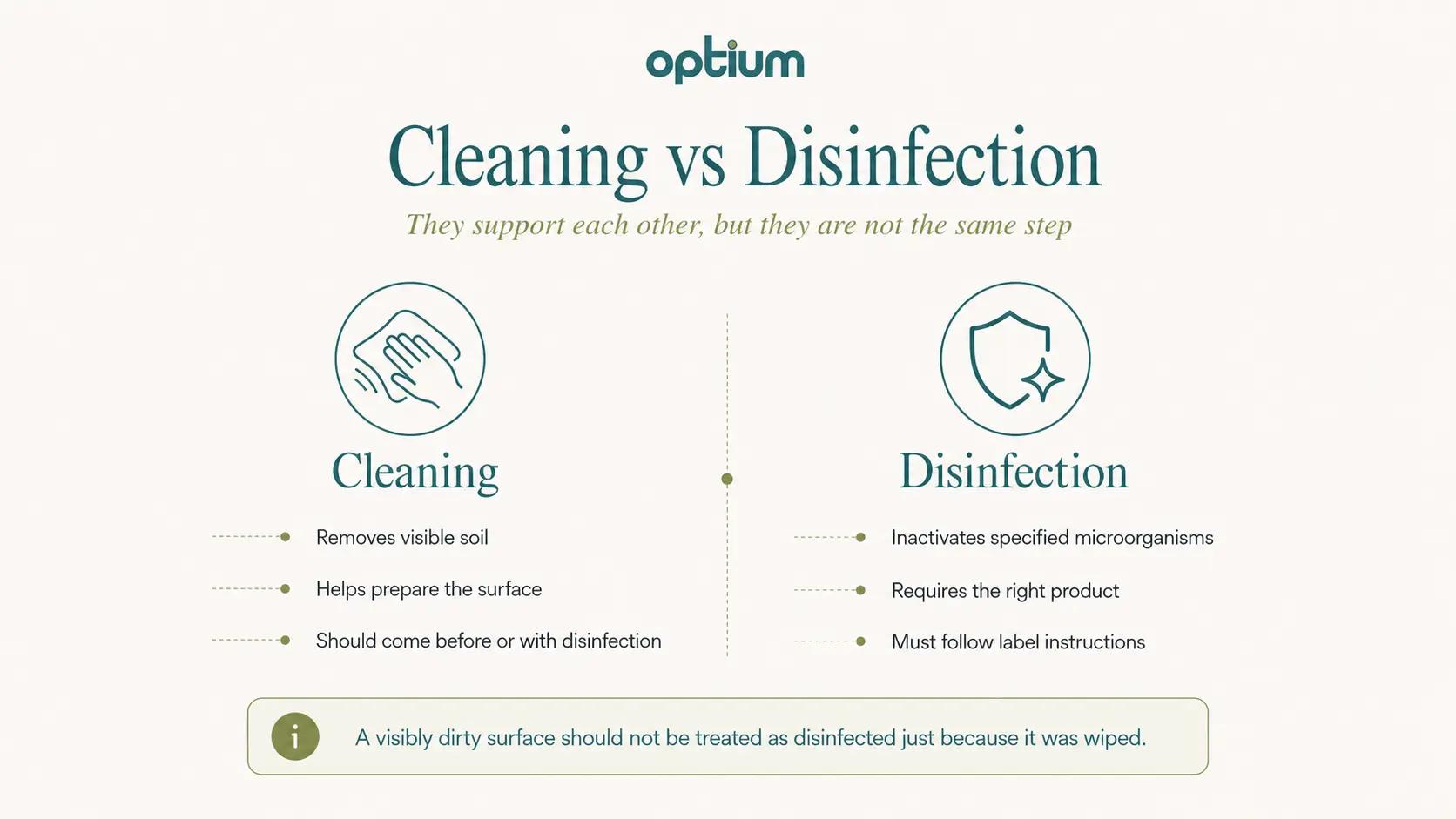
Cleaning removes visible soil, bodily material and other organic contamination from a surface. This physical removal is important because dirt and bodily fluids can reduce the effectiveness of a disinfectant.
Disinfection uses an appropriate chemical product and method to inactivate specified microorganisms that remain on the surface.
In some situations, a combined cleaner and disinfectant may be used according to its label. In other situations, a separate cleaning step is required before disinfection.
The correct process depends on the surface, contamination present, organism of concern, product label and facility procedure.
Wiping a visibly dirty surface with disinfectant does not necessarily complete both tasks correctly.
Hospitals should also follow the equipment manufacturer’s instructions. A disinfectant may be effective against a target organism but unsuitable for a particular mattress cover, plastic component, display or electrical housing.
Why Does Disinfectant Contact Time Matter?
A disinfectant needs sufficient time on the surface to work as specified.
This period is often called contact time or wet time.
The United States Environmental Protection Agency explains that a treated surface should remain visibly wet for the full contact time shown on the product label.
If a product requires ten minutes but the surface dries after five, the labelled process has not been completed unless the product is reapplied according to its instructions.
This creates a practical workflow challenge.
A disinfectant may perform well in laboratory testing but be difficult to use correctly when staff cannot keep a large bed surface wet for the required period.
Product selection should therefore consider the target organism, surface material, contact time, ventilation, occupational safety and equipment compatibility.
More concentrated does not automatically mean more effective. Incorrect dilution can reduce performance, damage surfaces or create unnecessary risk.
The best procedure is one that staff can perform correctly, consistently and within real working conditions.
Is Daily Cleaning the Same as Terminal Cleaning?
No.
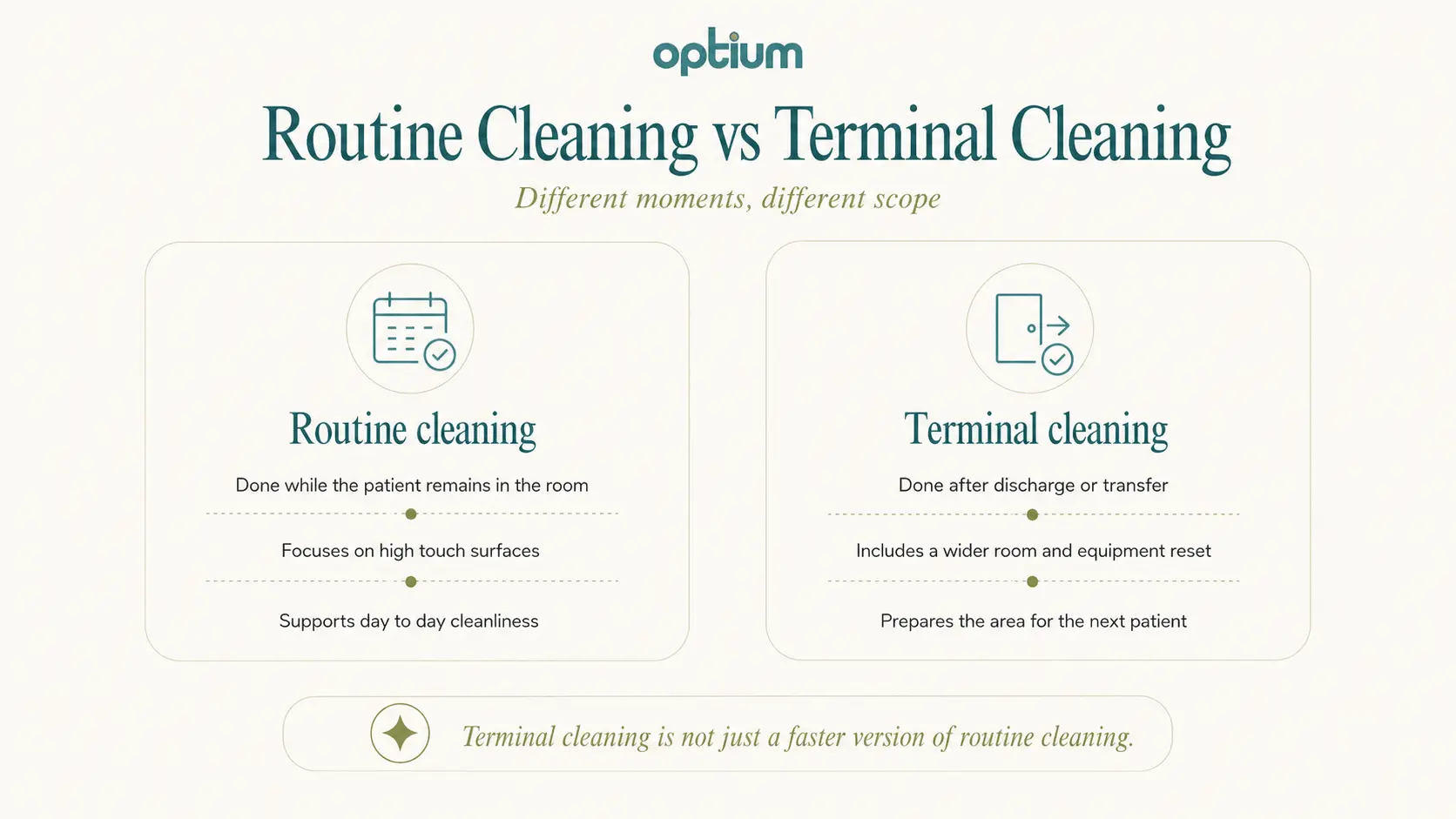
Daily cleaning takes place while the patient remains in the room. It focuses on maintaining the patient zone, removing visible contamination and addressing frequently touched surfaces.
Terminal cleaning takes place after the patient is discharged or transferred. Its purpose is to prepare the complete patient area and associated equipment for the next occupant.
Terminal cleaning usually includes surfaces that may not be accessible during routine care. The mattress may be removed, the platform exposed, movable furniture repositioned and accessories inspected more closely.
The exact process depends on the clinical department, the patient’s infection status, the organism of concern, local policy and the equipment manufacturer’s instructions.
A terminal clean is not simply a faster or stronger version of routine wiping. It is a wider room preparation process with a defined sequence and scope.
Hospitals should document which surfaces are included, who is responsible, which product is used and how completion is checked.
Can One Disinfectant Kill Every Organism?
No.
Different organisms have different levels of resistance. Disinfectants are registered or approved for specific uses and claims.
The CDC warns that not every disinfectant is effective against Candida auris. Clostridioides difficile spores also require products with suitable sporicidal claims.
Hospitals should not select disinfectants based only on fragrance, colour, convenience or a broad hospital use statement.
Selection should involve infection prevention teams, environmental services, occupational safety, biomedical engineering and the manufacturers of the surfaces being cleaned.
The facility must also confirm that the product is permitted under local regulations and used according to its label.
A product that is suitable for one room or organism may not be the correct choice for another.
Can Hospital Bed Design Prevent Infection?
No hospital bed can prevent infection by itself.
A bed cannot compensate for missed surfaces, incorrect dilution, insufficient contact time, poor hand hygiene or unclear staff responsibility.
Design can, however, make a validated cleaning process easier or harder to perform.
Cleanability may be supported by:
Smooth and accessible surfaces
Fewer unnecessary recesses
Removable mattress platforms
Detachable head and foot boards
Protected electrical components
Compatible covers and coatings
Accessible controls
Written cleaning instructions
Replaceable components where wear is expected
The goal is not to create a hospital bed with no joints or moving parts. That would be unrealistic for adjustable medical equipment.
The goal is to ensure that necessary functions do not create cleaning obstacles that the facility cannot manage consistently.
A design feature should not be presented as preventing infection unless evidence supports that claim. The more accurate statement is that accessible and compatible design can support a more consistent cleaning process.
What Should Procurement Teams Check Before Buying?
Terms such as hygienic, antibacterial and easy to clean should begin the evaluation rather than end it.
The procurement team should request the complete cleaning instructions and compare them with the hospital’s disinfectants, staffing model, maintenance process and expected room preparation time.
Seven practical questions can reveal more than a broad hygiene claim:
Which cleaning and disinfecting agents are approved for every surface?
Are dilution, contact time and drying instructions documented?
Can staff reach the rails, controls, mattress platform, frame and accessories in normal cleaning positions?
Which components can be removed without tools?
Which electrical or mechanical areas should never be sprayed or saturated?
What signs of wear require repair or replacement?
Can staff complete the documented process within realistic working conditions?
The answers should be assessed alongside patient safety, positioning, braking, mattress compatibility, maintenance, spare parts and supplier support.
Procurement should also involve the people who will use and maintain the equipment. Nursing, environmental services, infection prevention, facilities and biomedical engineering may notice practical limitations that are not visible in a brochure.
The objective is not to purchase the bed with the longest feature list. It is to select equipment that fits the patient population, department workflow, cleaning procedure and expected service life.
Should Hospitals Use the Strongest Possible Chemical?
Not automatically.
A chemical may be effective against the target organism while being unsuitable for a plastic surface, mattress cover, coating, adhesive, display or electrical enclosure.
Repeated exposure to an incompatible product can contribute to fading, brittleness, cracks, peeling or loss of surface integrity.
Once a cover or coating becomes damaged, it may become harder to clean effectively. Fluid may enter areas that were previously sealed, and worn surfaces may require replacement.
The correct process must achieve two objectives at the same time:
Appropriate control of the target organism
Preservation of a cleanable and functional equipment surface
Infection prevention and equipment preservation should not be treated as separate decisions.
The disinfectant label, facility policy and manufacturer’s cleaning instructions must be reviewed together.
What Can Patients and Families Do?
Patients and visitors should not attempt to disinfect hospital equipment with personal sprays or wipes.
Unapproved products may damage electrical components, react with facility chemicals or interfere with a required cleaning process.
Reasonable actions include cleaning hands as directed, avoiding unnecessary contact with clinical equipment and informing staff when a surface is visibly contaminated.
A patient or family member can also ask a straightforward question:
Could you tell me whether this control or table has been cleaned?
That question should not be treated as an accusation. Clear communication supports trust and helps patients understand how the care environment is managed.
Patients should also avoid placing phones, bags or personal items on clinical equipment unless staff confirm that the surface is appropriate for personal use.
The Most Important Lesson Is Not About One Surface
A hospital bed is not a single object from an environmental cleaning perspective.
It is a collection of rails, controls, boards, platforms, moving parts, accessories and nearby furniture. Different people use these components for different tasks.
The bed rail may be cleaned by one team. The handset may be considered nursing equipment. The IV pole may move with the patient. The mattress may be inspected by environmental services but replaced by another department.
Without clearly assigned responsibility, the gaps between these tasks can become more important than the performance of any individual disinfectant.
Hospitals need a repeatable system that defines:
What must be cleaned
Who cleans it
When it is cleaned
Which product is used
How long the surface remains wet
How completion is checked
What damage must be reported
The safest looking room is not necessarily the safest room.
A safer room is one in which cleaning is visible, teachable, realistic and auditable.
Hospital Hygiene Begins Before the Bed Enters the Ward
Cleaning quality is often discussed after equipment has already been purchased.
By then, many of the most important design decisions have been made.
If controls are difficult to wipe, the mattress platform cannot be accessed, approved chemicals damage the surface or replacement parts are unavailable, the cleaning team inherits a problem that procurement could have identified earlier.
A hospital bed cannot stop infection transmission by itself.
A bed designed around accessible surfaces, compatible materials, removable components and documented maintenance can make it easier for staff to perform the correct process every day.
For hospitals planning a new ward, replacing an ageing bed fleet or reviewing patient room furniture, the discussion should include infection prevention, nursing, environmental services, biomedical engineering and procurement from the beginning.
Hospital teams can contact Optium Healthcare to discuss hospital bed configurations, mattress compatibility, removable components and patient room equipment according to their department and cleaning workflow.
Frequently Asked Questions
How long can germs live on a hospital bed?
There is no single duration. Survival depends on the microorganism, surface material, moisture, temperature, organic contamination and cleaning conditions. Some organisms remain for much longer than others.
Are hospital bed rails considered high touch surfaces?
Yes. Bed rails are frequently handled by patients, healthcare workers and visitors. They should be included in the facility’s routine and terminal cleaning procedures.
Does changing hospital bed sheets clean the whole bed?
No. Changing linen addresses the sheets and related fabric items. The rails, controls, boards, mattress cover, mattress platform, frame and nearby furniture still require attention.
What is the difference between cleaning and disinfecting?
Cleaning removes visible dirt and organic material. Disinfection uses an appropriate product to inactivate specified microorganisms that remain on the surface.
What is disinfectant contact time?
Contact time is the period during which a treated surface must remain visibly wet for the disinfectant to perform according to its label.
Should a damaged hospital mattress cover be repaired?
A damaged cover requires assessment according to facility policy and manufacturer instructions. Tears, cracks, fluid penetration or persistent staining may mean the cover or complete mattress needs replacement.
Can antibacterial materials replace disinfection?
No. Material claims do not replace routine cleaning, appropriate disinfection, hand hygiene, staff training or infection prevention procedures.
What is terminal cleaning?
Terminal cleaning is the comprehensive cleaning and disinfection process performed after a patient is discharged or transferred. It prepares the patient area and associated equipment for the next occupant.
Should the same disinfectant be used in every hospital room?
Not necessarily. Product selection depends on the organism of concern, surface material, clinical area, local regulations, facility policy and manufacturer instructions.
Can hospital bed design prevent healthcare associated infections?
No hospital bed can prevent infection by itself. Accessible surfaces, compatible materials and removable components can support cleaning, but they cannot replace infection prevention practices.
Sources and Methodology
This article was prepared using environmental cleaning and infection prevention guidance from the Centers for Disease Control and Prevention, the World Health Organization and the United States Environmental Protection Agency.
Examples concerning organism persistence were drawn from current CDC information about Candida auris and Clostridioides difficile.
These examples illustrate why persistence varies between organisms. They should not be interpreted as proof that a specific hospital bed is contaminated or likely to transmit infection.
Cleaning and disinfection procedures must follow local regulations, facility infection prevention policies, product labels and the medical equipment manufacturer’s instructions.
This content is intended for general education and healthcare planning. It does not provide patient specific medical advice or replace decisions made by qualified infection prevention and healthcare professionals.