



A delivery bed can appear to be a straightforward item on a hospital equipment list. It provides a mattress platform, supports different positions and gives clinical staff access to the patient during labor and birth.
But that description hides the real procurement challenge.
Maternity units do not simply need a surface on which a patient can lie. They need equipment that can support several stages of care, accommodate different birth positions, allow rapid clinical access, reduce unnecessary transfers and remain practical to clean and reposition between patients.
This is where many purchasing decisions go wrong. A hospital may select a gynecology table for a workflow that actually requires a complete delivery bed. Another facility may invest in a highly equipped electric birthing bed when its outpatient examination rooms need a simpler gynecology table.
Both products may have leg supports, fluid basins and adjustable backrests. That does not make them interchangeable.
Quick Answer: How Do You Choose the Right Delivery Bed?
Choose a delivery bed when the patient may remain on the same platform during labor, birth, immediate post-delivery care or clinical observation. Choose a gynecology table when the primary purpose is examination, diagnosis or a relatively short procedure.
The correct decision depends on five factors: the stage of care, expected patient duration, required birth positions, transfer strategy and level of clinical access.
A delivery bed should support the maternity workflow as a whole. A gynecology table should support a defined examination or procedural task.
The Real Question Is Not “Which Bed Has More Features?”
The first procurement question should not be how many motors the bed has, whether it includes a remote control or how many accessories appear on the specification sheet.
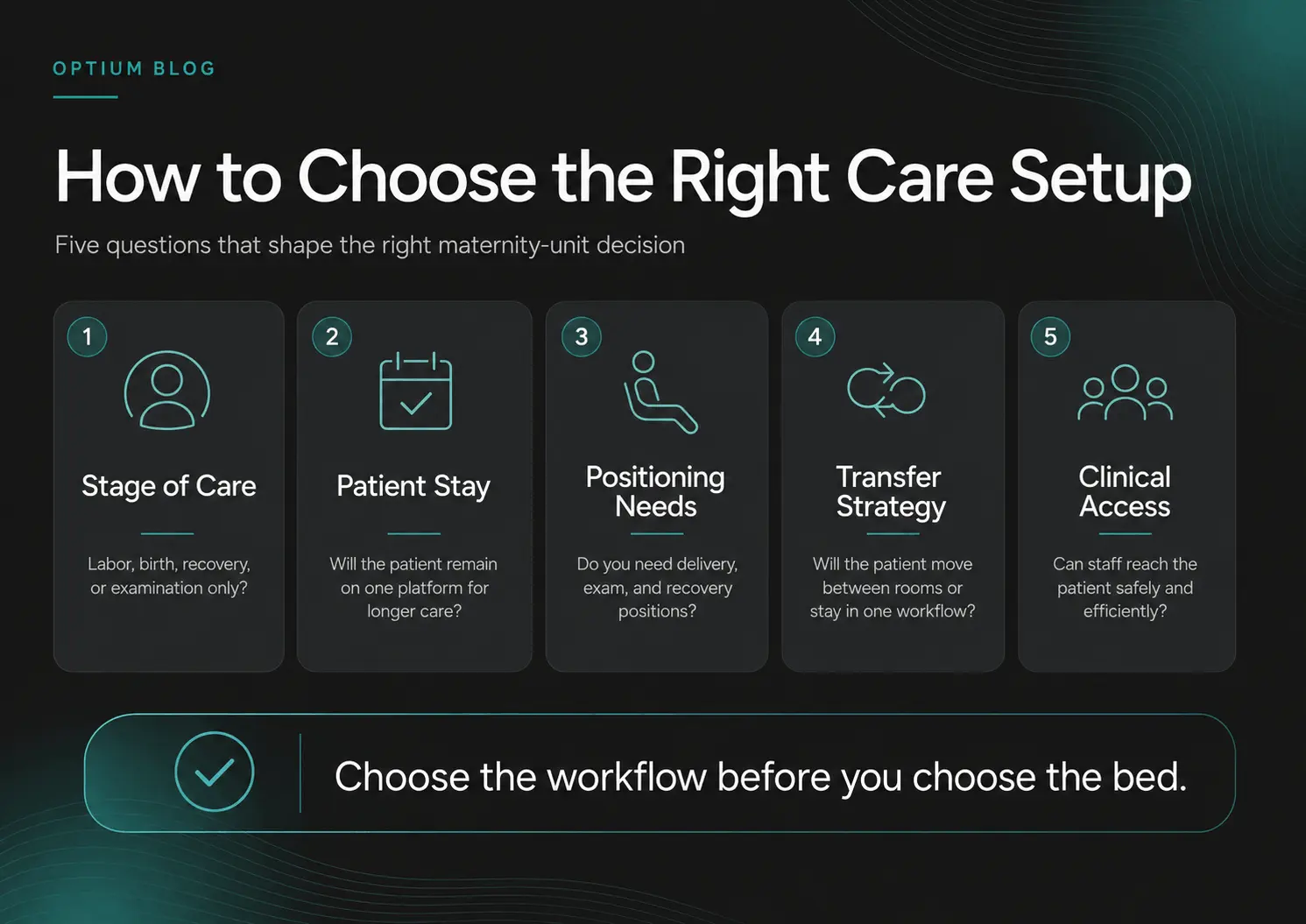
The first question should be:
What must happen on this bed from the moment the patient arrives until she leaves the maternity area?
A patient may be admitted during early labor, monitored as labor progresses, repositioned several times, assisted during birth and observed after delivery. In some maternity models, the aim is to complete much of this process without repeatedly transferring the patient between separate pieces of equipment.
A delivery bed designed around this workflow is different from a table designed primarily to provide lithotomy positioning during a gynecological examination.
Optium’s delivery beds and gynecology tables category reflects this distinction by including electric and hydraulic birthing beds alongside electric, mechanical and stainless-steel gynecology tables. The products belong to the same clinical category, but they support different levels and durations of care.
When Does a Hospital Need a Full Delivery Bed?
A complete delivery bed is generally the stronger choice when a facility wants one platform to support multiple stages of maternity care.
The patient may need to change from a relatively flat resting position to an elevated backrest, a more upright labor position or a configuration that gives the clinical team better access during birth. After delivery, the platform may need to return to a conventional bed arrangement for recovery and observation.
This requires more than adjustable leg supports.
A delivery bed may need to provide:
A full-length lying surface for rest and observation
Adjustable height for clinical access and patient entry
Backrest and leg-section movement
Trendelenburg and reverse Trendelenburg positioning
A removable or sliding foot section
Patient hand grips, leg supports or a squatting bar
A removable fluid basin
Side rails and protective bumpers
Central braking and directional control
Battery backup for movement during power interruptions
Not every maternity unit needs every feature. However, the bed should support the facility’s intended model of care without requiring staff to improvise around missing functions.
WHO’s guidance on positive childbirth experiences identifies mobility during labor and the ability to choose a birth position as important components of respectful, person-centered maternity care. Equipment alone does not create that model of care, but a bed that supports varied positioning can make it easier for clinical teams to accommodate appropriate patient movement and positioning choices.
When Is a Gynecology Table the Better Choice?
A gynecology table is usually more appropriate when the main purpose is examination, diagnosis, consultation or a shorter gynecological procedure.
In this environment, the patient is not expected to remain on the table throughout labor, delivery and recovery. The table instead needs to provide reliable clinical access, comfortable positioning and a practical working height.
An adjustable gynecology table may include a backrest, height movement, Trendelenburg positioning, leg supports, a removable fluid basin, paper-roll support and a detachable foot extension.
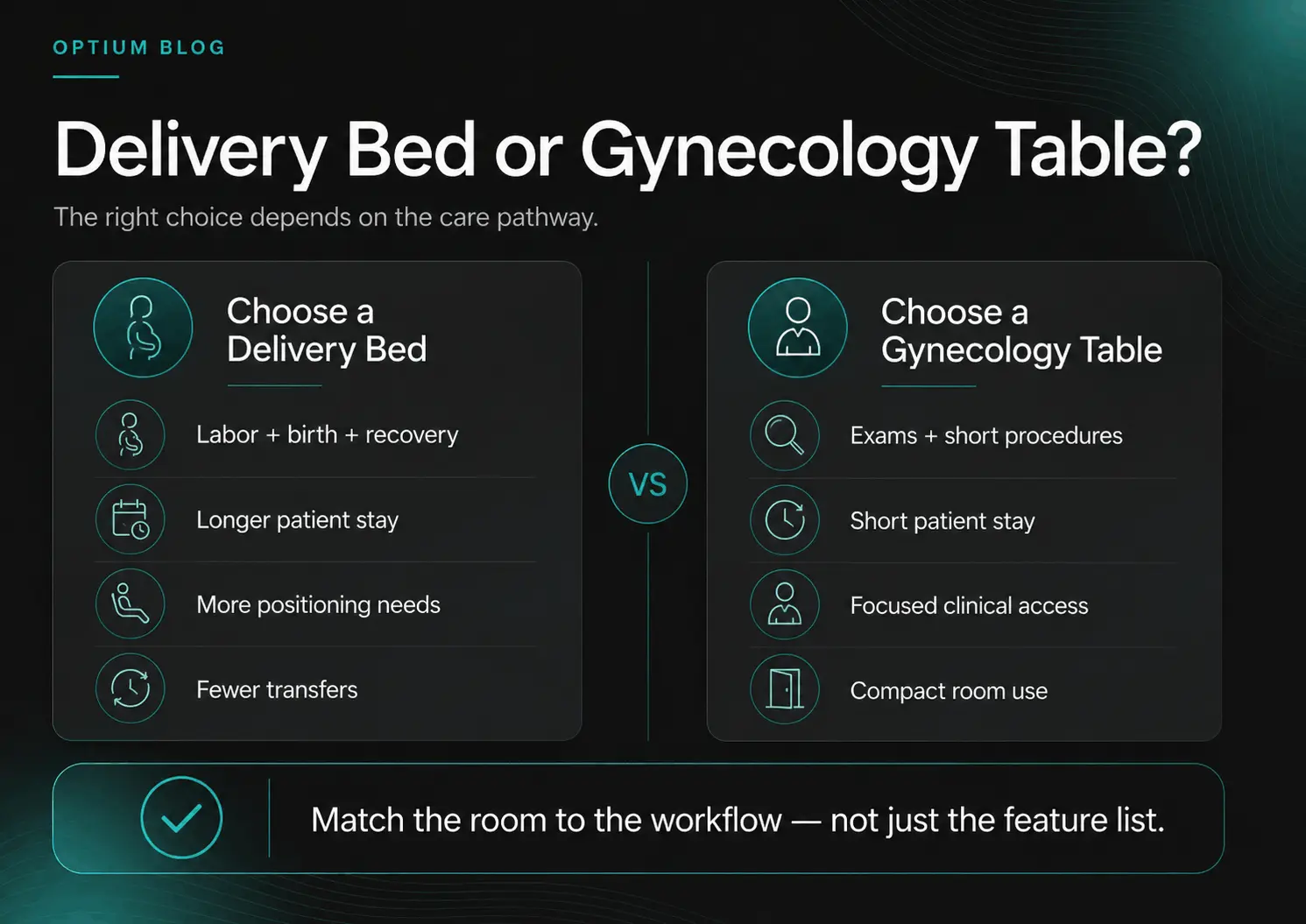
These features can make the table highly capable without turning it into a delivery bed.
For example, the GYNEA 3 electric gynecology table uses three motors to control the backrest, height and Trendelenburg or reverse Trendelenburg positions. It also includes adjustable leg supports, a removable stainless-steel fluid basin and a removable foot extension. That configuration is designed around gynecological examinations rather than continuous labor and post-delivery care.
A gynecology table can therefore be the correct and more efficient purchase for outpatient departments, women’s health clinics and examination rooms. The mistake is not choosing a gynecology table. The mistake is expecting it to perform a complete maternity-bed workflow for which it was not designed.
For a broader examination-room perspective, the guide to essential examination table features explains how adjustability, patient access, cleaning and room layout affect table selection outside the delivery environment.
Why Patient Transfers Should Influence the Decision
A maternity bed is not only a positioning device. It can also be part of the facility’s patient-transfer strategy.
Every planned transfer requires staff coordination, space and suitable equipment. Transfers may also become more difficult when the patient is in pain, connected to monitoring equipment or experiencing rapid changes in labor.
A delivery bed that converts between labor, delivery and recovery configurations may reduce the need to move the patient onto a separate platform at each stage. This does not mean all transfers can or should be eliminated. Clinical circumstances and local protocols still determine what is appropriate.
It means the hospital should understand its intended transfer pathway before buying the bed.
Procurement teams should map the patient journey in practical terms:
Where is the patient first assessed?
Is she transferred to a dedicated labor room?
Will birth occur in the same room?
Where will immediate recovery take place?
When and how will the patient be transferred to the postnatal unit?
Can the selected bed move safely through the required doors, corridors and lifts?
Which accessories or monitoring devices must remain attached during movement?
Without this workflow map, a hospital can purchase a sophisticated product that does not fit its rooms or a compact table that creates avoidable transfers.
Positioning Is a Clinical Workflow Issue, Not a Specification-Page Feature
Manufacturers often list backrest movement, leg-section adjustment and Trendelenburg positioning as individual features. Procurement teams should instead evaluate how these movements work together.
Can the backrest be adjusted while the patient remains supported? Can the foot section be removed or moved without interfering with clinical access? Are the leg supports easy to position and lock? Can the bed return to a conventional lying configuration after delivery?
These questions reveal more than the number of motors.
The OBSTETRA electronic delivery bed, for example, electrically adjusts the backrest, leg section, height and Trendelenburg positions. It uses a three-section HPL mattress platform, includes a sliding foot section and can convert into a conventional bed configuration. Its positioning system is supported by delivery-specific accessories such as adjustable leg supports, patient hand grips, heel supports and a squatting bar.
The important point is not that every facility must purchase this exact configuration. It is that delivery-bed functions should be evaluated as one connected workflow rather than as isolated items on a checklist.
Electric, Hydraulic or Mechanical: Which Adjustment System Makes Sense?
Electric adjustment is often attractive because staff can change several positions through a control unit without relying on repeated manual effort. It can be particularly useful in high-volume maternity units, where beds are repositioned frequently and consistent adjustment is important.
However, an electric bed also introduces requirements relating to power access, battery management, control systems and technical maintenance.
A hydraulic delivery bed can provide height adjustment without depending entirely on an electric actuator system. Backrest and other movements may use gas springs or manual mechanisms. This can be a practical option when the facility wants adjustable positioning with a simpler technical structure.
The RO 58 hydraulic birthing bed, for example, uses foot-pedal hydraulic height adjustment and a gas-spring backrest. It includes a removable footrest mattress, stainless-steel waste bowl, adjustable thigh supports and centrally braked castors with steering control. Trendelenburg and reverse Trendelenburg are available as optional gas-spring functions.
Mechanical gynecology tables can be suitable for facilities with lower examination volumes, limited technical infrastructure or workflows that do not require frequent powered adjustment. Their lower complexity can be an advantage, but staff effort and adjustment speed should still be assessed.
The correct system is therefore not automatically the one with the most motors. It is the one that balances clinical frequency, staff workload, maintenance capacity and budget.
The Most Expensive Bed Can Still Be the Wrong Bed
A common procurement assumption is that a more advanced model will cover every possible need.
In reality, unnecessary complexity can create its own problems.
A highly equipped delivery bed may occupy more space than an outpatient examination room can comfortably accommodate. Additional accessories may go unused. Staff may receive insufficient training because only a small portion of the functions are relevant to their work.
The reverse problem is equally serious. A hospital may choose a simpler table to reduce the initial purchase cost, then discover that staff must repeatedly transfer patients, use separate equipment for positioning or work around inadequate access during birth.
The lowest initial price and the highest feature count can both lead to poor value.
Lifecycle value depends on whether the equipment fits the care pathway, can be maintained locally and remains usable throughout its expected service life.
How Room Layout Changes the Right Answer
The bed must be evaluated inside the room where it will be used.
A product can appear compact in a catalogue and still become difficult to operate after side access, staff movement, medical devices, companion seating and emergency circulation space are considered.
Measure more than the bed footprint. Procurement teams should also consider:
The space required when the foot section is extended or removed
Clearance for staff on both sides
The turning radius of the bed
The direction in which drawers, rails and accessories move
Access to power outlets and medical gases
Door, lift and corridor dimensions
Space for infant-care and monitoring equipment
The location of waste and cleaning processes
A powered gynecology couch can sometimes be a strong solution for a compact but high-volume examination room. The MATERNEUM electronic gynecology couch, for instance, combines powered backrest, height and Trendelenburg adjustment with a three-section design, removable fluid basin and retractable rolling system. Its format serves a different room and workflow requirement from a full maternity bed.
Hygiene Depends on the Entire Design
An “easy-to-clean” mattress description is not enough to determine whether a bed will fit the facility’s infection-prevention process.
The clinical team should examine the entire structure.
Seams, joints, accessory rails, control panels, fluid basins, side rails and removable components can all influence cleaning time. Procurement teams should ask whether staff can reach the surfaces most likely to become contaminated and whether removable components can be detached without complicated tools.
The upholstery or mattress cover should be evaluated for its resistance to fluids and the cleaning agents used by the facility. The platform beneath the mattress should not create unnecessary traps for liquids or debris.
The hospital should also consider how quickly the product must be turned around between patients. A design that takes substantially longer to clean may become an operational bottleneck in a busy maternity unit, even when it performs well clinically.
What Should Buyers Test Before Placing a Large Order?
A product demonstration should involve more than raising and lowering the platform.
The people who use the bed should perform realistic tasks. Midwives, nurses, physicians, cleaning personnel, biomedical teams and porters may notice different problems.
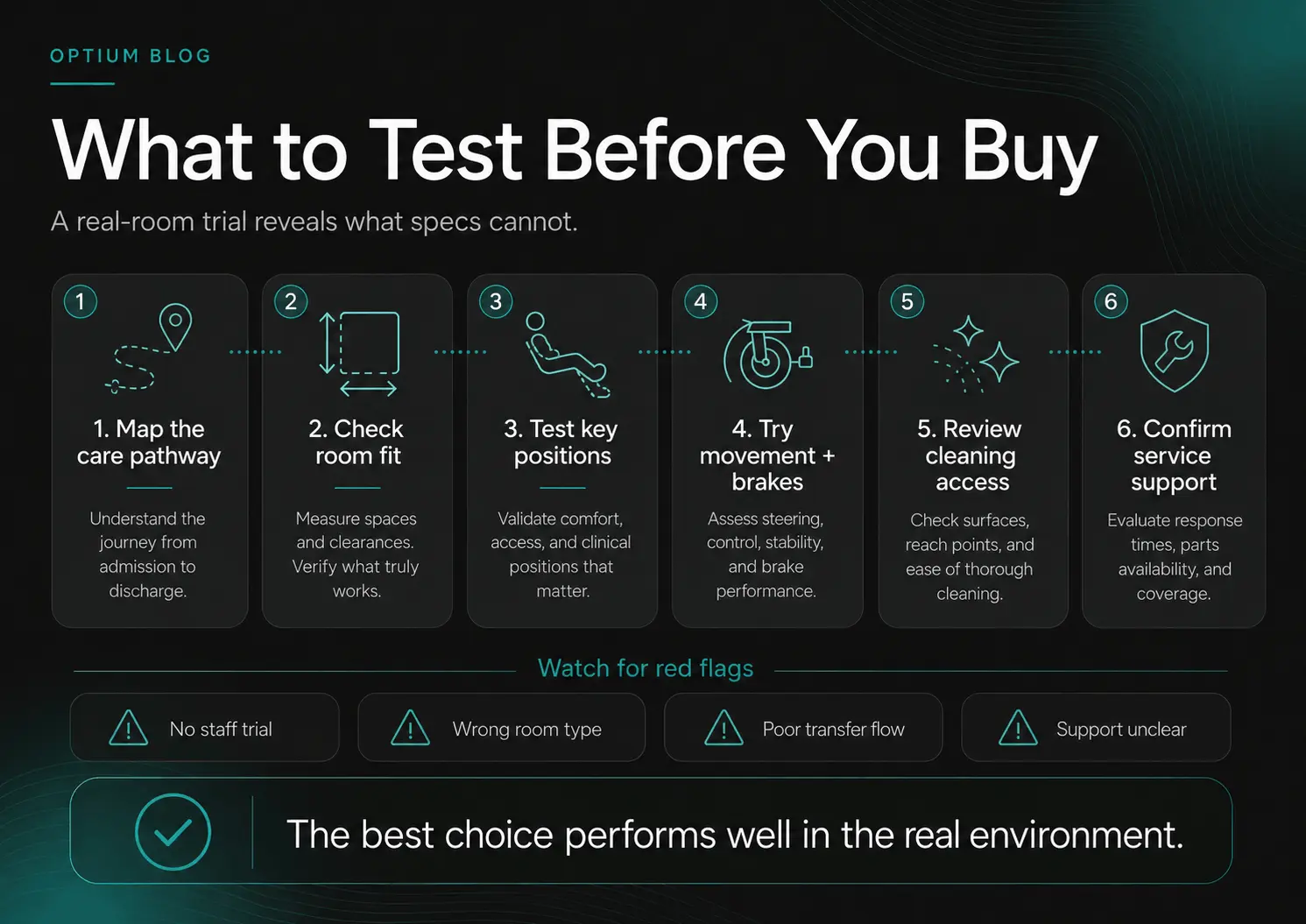
A meaningful evaluation should include:
Helping a patient enter and leave the bed
Moving between common labor and delivery positions
Removing and reinstalling the foot section
Adjusting leg supports and patient hand grips
Applying and releasing the brakes
Moving the fully configured bed through the intended route
Cleaning the mattress platform, rails and accessories
Returning the bed to its normal recovery configuration
Using the controls during a simulated power interruption
Confirming that replacement components and technical support are available
A short trial can reveal that a control is difficult to reach, a removable section is too heavy, an accessory obstructs the clinician or the bed cannot turn comfortably inside the room.
These findings are far more useful than comparing brochures alone.
Warning Signs That the Selected Bed May Be Wrong
The equipment choice deserves another review when the purchasing decision is based mainly on price, appearance or motor count.
Other warning signs include:
The intended care pathway has not been mapped
The same product is being specified for delivery rooms and examination rooms without a workflow review
Room dimensions have not been confirmed
Clinical staff have not tested the product
The bed cannot support the positions used by the maternity team
Cleaning and maintenance teams were not consulted
Essential accessories are being treated as later additions
Battery backup and emergency positioning have not been evaluated
The supplier cannot explain spare-part or service availability
One warning sign does not automatically disqualify a product. Several of them together suggest that the procurement process is being driven by the catalogue rather than the clinical environment.
How Should a Hospital Make the Final Choice?
Begin by separating the rooms according to their real purposes.
A delivery room requires equipment that supports labor, birth and immediate recovery. A gynecology examination room requires efficient positioning and clinical access for shorter visits. A procedure room may need a powered couch with additional stability and accessory options.
Once those roles are defined, compare only products that genuinely fit each role.
A practical decision sequence is:
Define the care pathway.
Identify the required positions and accessories.
Measure the room and transport routes.
Decide whether electric, hydraulic or mechanical adjustment suits the workload.
Review cleaning and maintenance requirements.
Conduct a real or simulated user trial.
Compare lifecycle support, not only purchase price.
This process prevents the facility from buying one compromise product for several incompatible workflows.
Frequently Asked Questions
What is the main purpose of a delivery bed?
A delivery bed supports patients during labor, birth and immediate post-delivery care. It may provide multiple positioning functions, a removable foot section, delivery accessories and the ability to return to a conventional lying configuration.
Can a gynecology table be used as a delivery bed?
A gynecology table should not automatically be used as a delivery bed. It may support examinations and some procedures, but it may not provide the full-length platform, mobility, accessories or continuous-care configuration required for labor and recovery.
How many motors should an electric delivery bed have?
There is no universally correct motor count. Buyers should identify which movements must be powered, such as height, backrest, leg section and Trendelenburg. The required functions matter more than the motor number shown in the product name.
Is an electric delivery bed always better than a hydraulic bed?
No. Electric adjustment can improve convenience in high-volume environments, while hydraulic systems may offer simpler operation and maintenance. The best option depends on workload, infrastructure, maintenance capacity and required positioning.
Why does a removable foot section matter?
A removable or sliding foot section can improve clinical access during delivery and allow the bed to change between a full lying surface and a delivery configuration. Buyers should test how easily staff can move and store the section.
Should a delivery bed have battery backup?
Battery backup can allow powered functions to remain available during power interruptions or bed movement. Whether it is essential depends on the facility’s electrical infrastructure, emergency procedures and transfer workflow.
What should be checked during a delivery bed demonstration?
Test patient entry, height adjustment, labor and delivery positions, brakes, castors, accessories, foot-section removal, cleaning access and emergency controls. The trial should involve clinical, cleaning, transport and technical staff.
What is the difference between a birthing bed and an obstetric bed?
The terms are often used interchangeably. Both generally refer to a bed designed to support labor and childbirth. Product capabilities can vary significantly, so buyers should compare the actual positioning, mobility and accessory configuration rather than relying on the name alone.
Choose the Workflow Before You Choose the Bed
The wrong delivery bed is not necessarily a low-quality product. It may simply be a product selected for the wrong room, care pathway or clinical workload.
A full delivery bed should support the stages of maternity care that the facility intends to complete on one platform. A gynecology table should provide focused positioning and access for examinations or shorter procedures. An electric couch may fill the space between those requirements for specific clinical settings.
The safest procurement approach is to define the workflow first, test the equipment in realistic conditions and compare configurations according to long-term clinical use.
Explore Optium’s patient care systems to review delivery beds, gynecology tables and other hospital equipment designed for different departments and care environments.