


Hospital beds per 1,000 people is one of the clearest public indicators for comparing inpatient capacity across countries. In this ranking, we compare Arab League countries using the latest available World Bank / WHO data to show which health systems report the highest bed density.
Your trusted partner in medical equipment solutions.
For hospital planners, procurement teams and healthcare investors, bed density is not just a public-health statistic. It can help frame discussions around inpatient infrastructure, ward capacity, ICU readiness, long-term care needs and the procurement of patient-care equipment such as electrical hospital beds, manual beds and critical-care bed systems.
Answer in brief
Libya ranks first among Arab League countries in the latest available World Bank / WHO hospital beds per 1,000 people data used for this analysis, followed by Lebanon, Saudi Arabia and Kuwait. However, this ranking should be read as a high-level inpatient capacity comparison, not a complete measure of healthcare quality.
Arab League countries reviewed for this ranking.
top ranking positions shown, including a tie at the final position.
highest latest available value in this Arab League comparison.
used as the recent-data window for the secondary ranking view.
Methodology
Scope of the ranking
This article ranks the 22 countries listed as members of the League of Arab States: Algeria, Bahrain, Comoros, Djibouti, Egypt, Iraq, Jordan, Kuwait, Lebanon, Libya, Mauritania, Morocco, Oman, Palestine, Qatar, Saudi Arabia, Somalia, Sudan, Syria, Tunisia, the United Arab Emirates and Yemen.
Primary data source
The ranking uses the World Bank indicator SH.MED.BEDS.ZS, which reports hospital beds per 1,000 people. The indicator is based on World Health Organization data supplemented by country data. Values are shown using the latest available year for each country, which means not every country has data for the same year.
Data freshness labels
- Recent: latest available value from 2021–2023
- Older: latest available value from 2010–2020
- Very old: latest available value before 2010
Important note
Because hospital bed definitions and reporting methods can vary by country, this ranking should be used as a capacity benchmark, not as a direct ranking of healthcare quality, clinical outcomes or hospital service performance.
Who ranks first?
Short answer for researchers
Libya ranks first among Arab League countries in the latest available hospital beds per 1,000 people data used for this analysis, with 3.50 hospital beds per 1,000 people reported for 2022. Lebanon ranks second, followed by Saudi Arabia and Kuwait.
Citation-ready summary: Using latest available World Bank / WHO data, Libya has the highest reported hospital bed density among Arab League countries, at 3.50 hospital beds per 1,000 people. The figure reflects reported inpatient bed capacity, not overall healthcare quality.
Top 15 ranking
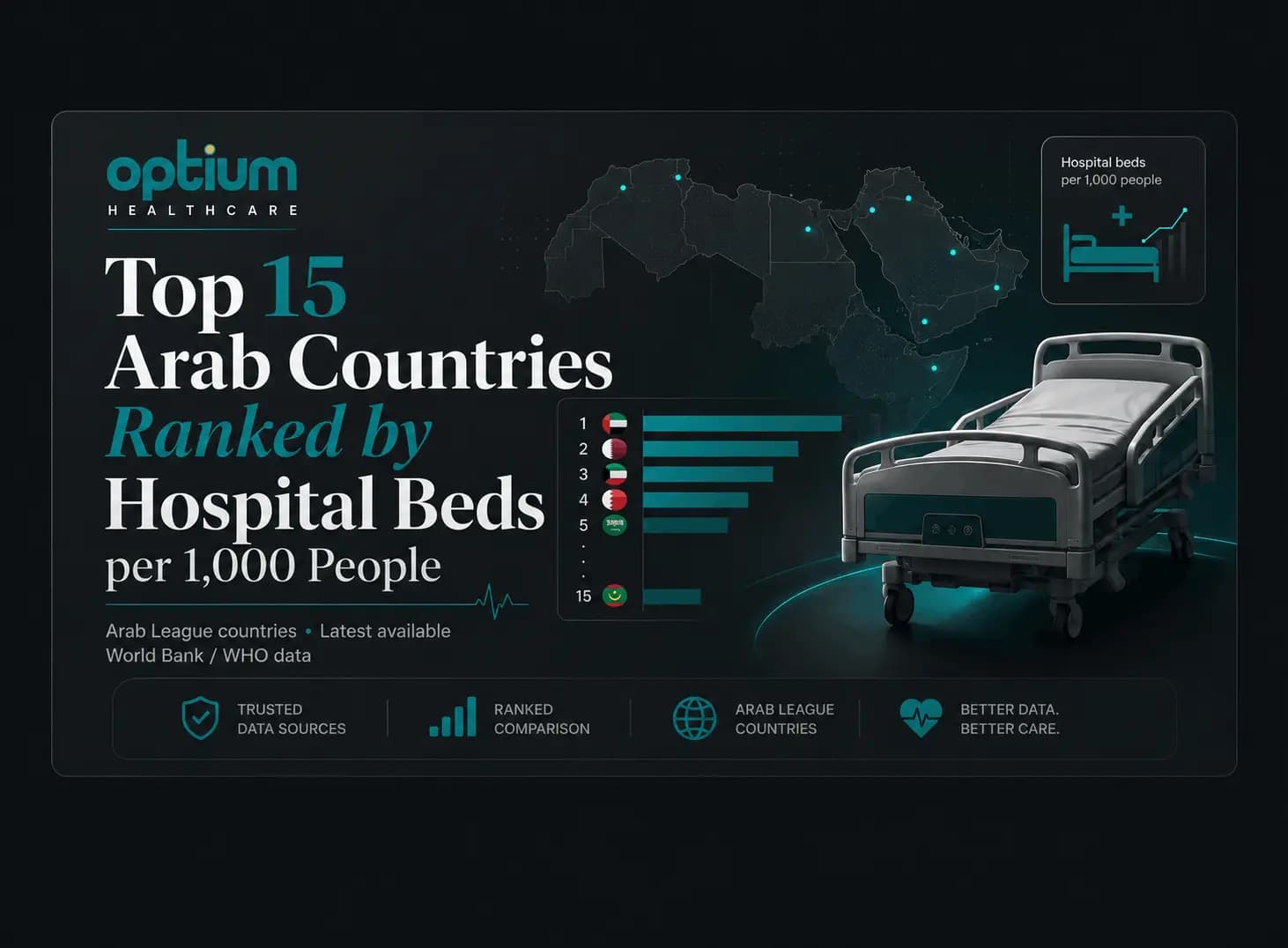
Arab countries by hospital beds per 1,000 people
The table below ranks Arab League countries by latest available hospital bed density. Egypt and Iraq are tied at the final position, so both are shown to avoid hiding an equal value.
| Rank | Country | Hospital beds per 1,000 people | Latest available year | Data freshness | Planning insight |
|---|---|---|---|---|---|
| 1 | Libya | 3.50 | 2022 | Recent | Highest reported bed density among Arab League countries in the latest available dataset. |
| 2 | Lebanon | 2.73 | 2021 | Recent | High inpatient bed density compared with most Arab League peers. |
| 3 | Saudi Arabia | 2.41 | 2023 | Recent | Strong capacity position with recent data. |
| 4 | Kuwait | 2.33 | 2020 | Older | Upper-tier bed density among Gulf countries, but not in the 2021–2023 recent-data window. |
| 5 | Comoros | 2.16 | 2010 | Older | High rank, but the data year is old and should be interpreted with caution. |
| 6 | United Arab Emirates | 1.87 | 2022 | Recent | Moderate bed density with a modern healthcare infrastructure context. |
| 7 | Bahrain | 1.84 | 2022 | Recent | Comparable to Tunisia and the UAE in reported bed density. |
| 8 | Tunisia | 1.82 | 2023 | Recent | One of the stronger North African performers by latest reported value. |
| 9 | Algeria | 1.61 | 2017 | Older | Mid-ranking position, but the latest available value is older than many peers. |
| 10 | Syria | 1.43 | 2021 | Recent | Reported capacity should be interpreted carefully due to healthcare system disruption risks. |
| 11 | Jordan | 1.41 | 2023 | Recent | Recent data places Jordan slightly below Syria and Algeria in bed density. |
| 12 | Djibouti | 1.40 | 2018 | Older | Close to Jordan and Syria, but based on older available data. |
| 13 | Palestine / West Bank and Gaza | 1.30 | 2022 | Recent | Lower-middle ranking, with capacity planning highly sensitive to access and infrastructure constraints. |
| 14 | Qatar | 1.25 | 2022 | Recent | Lower than some Gulf peers by bed density, although the metric alone does not measure overall system quality. |
| 15 | Egypt | 1.06 | 2021 | Recent | Large population size means absolute bed needs can be substantial even when per-capita density is moderate to low. |
| 15 | Iraq | 1.06 | 2018 | Older | Tied with Egypt in the latest available value, but based on older data. |
Source note: Values are latest available World Bank / WHO hospital beds per 1,000 people data, cross-checked against WDI latest country values. Ranking is based on reported value, not healthcare outcomes, hospital quality, ICU capacity, staffing levels or bed modernization.
Recent-data view
Ranking using 2021–2023 data only
Because some countries rely on older values, the table below shows a secondary view using only Arab League countries with latest available data from 2021 to 2023. This helps readers compare countries with more recent reporting.
| Recent-data rank | Country | Hospital beds per 1,000 people | Latest year | Why it matters |
|---|---|---|---|---|
| 1 | Libya | 3.50 | 2022 | Still ranks first when older pre-2021 values are excluded. |
| 2 | Lebanon | 2.73 | 2021 | Maintains a high position in the recent-data view. |
| 3 | Saudi Arabia | 2.41 | 2023 | Highest 2023 value among Arab League countries in this dataset. |
| 4 | United Arab Emirates | 1.87 | 2022 | Ranks higher when older Kuwait and Comoros values are excluded. |
| 5 | Bahrain | 1.84 | 2022 | Close to UAE and Tunisia in the recent-data comparison. |
| 6 | Tunisia | 1.82 | 2023 | Recent North African benchmark in the 2021–2023 view. |
| 7 | Syria | 1.43 | 2021 | Included as recent data, but interpretation requires caution. |
| 8 | Jordan | 1.41 | 2023 | Recent reporting makes it useful for regional comparison. |
| 9 | Palestine / West Bank and Gaza | 1.30 | 2022 | Capacity analysis should consider access and infrastructure constraints. |
| 10 | Qatar | 1.25 | 2022 | Lower bed density than several Gulf peers in this metric. |
| 11 | Egypt | 1.06 | 2021 | Population scale makes absolute capacity planning especially important. |
| 12 | Oman | 0.99 | 2023 | Recent value below the top Gulf group by bed density. |
| 13 | Morocco | 0.73 | 2023 | Recent data indicates low reported bed density. |
| 14 | Sudan | 0.66 | 2021 | Interpretation should consider healthcare system stress and access constraints. |
| 15 | Yemen | 0.46 | 2023 | Very low reported bed density in the recent-data view. |
Below the top 15
Remaining Arab League countries
The remaining Arab League countries with available values are important for regional planning because lower reported bed density can indicate potential demand for hospital infrastructure, modernization projects or better distribution of inpatient capacity.
| Country | Hospital beds per 1,000 people | Latest available year | Data freshness | Planning note |
|---|---|---|---|---|
| Oman | 0.99 | 2023 | Recent | Recent data; bed density is below the top-ranking Gulf countries. |
| Somalia | 0.87 | 2019 | Older | Lower reported bed density with infrastructure and access considerations. |
| Morocco | 0.73 | 2023 | Recent | Recent data; low bed density may create capacity planning pressure in high-demand regions. |
| Sudan | 0.66 | 2021 | Recent | Reported value should be interpreted with caution due to healthcare system stress. |
| Yemen | 0.46 | 2023 | Recent | Very low reported bed density and a high-need environment for healthcare infrastructure. |
| Mauritania | 0.40 | 2006 | Very old | Lowest reported value, but the data is very old and should not be treated as a current operational snapshot. |
Key insights
1. Libya leads the ranking
Libya reports the highest latest available hospital bed density among Arab League countries at 3.50 beds per 1,000 people. That places it above Lebanon, Saudi Arabia and Kuwait in this specific metric.
2. Gulf countries vary widely
Saudi Arabia and Kuwait rank near the top, while the UAE, Bahrain, Qatar and Oman sit lower in the table. This does not automatically mean one system is better than another. Bed density can be influenced by hospital design, service delivery models, private-sector capacity, outpatient systems and reporting methods.
3. Latest year changes the interpretation
Some countries have recent 2023 values, while others rely on older data. Comoros and Mauritania are especially important examples: their reported values are based on 2010 and 2006 data, so they should be read with extra caution.
4. Bed density is not quality
A higher hospital beds per 1,000 people figure can indicate more inpatient capacity, but it does not prove better clinical outcomes, higher staffing quality, better ICU readiness or stronger patient experience.
What the metric means
Hospital beds per 1,000 people explained
Hospital beds per 1,000 people measures the number of available inpatient beds relative to population size. It can include beds in public, private, general and specialized hospitals, and may also include rehabilitation centers depending on national reporting methods.
Why it matters for healthcare planning
- Capacity planning: It helps policymakers and healthcare systems estimate inpatient infrastructure availability.
- Emergency readiness: It can support discussions around surge capacity, disaster response and high-acuity care.
- Procurement strategy: It creates a data-led foundation for bed replacement, ward expansion and modernization projects.
- Regional benchmarking: It allows healthcare planners to compare broad inpatient capacity across countries.
Important: There is no universal “ideal” hospital beds per 1,000 people ratio. A good level depends on demographics, disease burden, care model, geography, hospital staffing, utilization rates and health system design.
Procurement angle
Turning data into equipment planning
For hospitals and healthcare groups, bed density data becomes more useful when connected to practical procurement questions. A country or region with low bed density may need new facilities, but a hospital with older infrastructure may also need bed modernization, safer bed systems, better ICU configurations or more standardized equipment fleets.
What procurement teams should review
- Department type: general ward, ICU, emergency, recovery, long-term care or specialty units.
- Bed specification: manual, semi-electric, fully electric, ICU, pediatric or specialty bed requirements.
- Patient acuity: whether the department needs Trendelenburg, reverse Trendelenburg, CPR or battery backup.
- Fleet standardization: how many different bed models the hospital already manages.
- Maintenance access: whether motors, side rails, castors and control systems are serviceable.
- Lifecycle value: warranty, spare parts, training, cleaning compatibility and long-term support.
Hospitals planning upgrades can start by comparing Optium’s electrical beds, manual beds and wider medical equipment product range. Higher-acuity departments can also review ICU-oriented options such as the Electronic ICU Bed IN 45 and Electronic ICU Bed CL 43.
Internal link map
Useful Optium pages for readers
| Reader need | Recommended internal page |
|---|---|
| Compare electric bed options | Electrical Beds |
| Review manual bed alternatives | Manual Beds |
| Explore all medical equipment categories | All Products |
| Evaluate ICU bed requirements | Electronic ICU Bed IN 45 |
| Review patient-care electric beds | Electronic Patient Bed TI 32 |
| Plan emergency transport workflows | Patient Stretcher Traveler |
| Request product information | Contact Optium |
Data limitations
What this ranking does not show
- It does not measure hospital quality.
- It does not show ICU beds separately.
- It does not show bed occupancy rates.
- It does not measure staff availability per bed.
- It does not show whether beds are modern, electric, manual or fully equipped.
- It does not show regional distribution inside each country.
Why the latest year differs
International health datasets often combine country-reported data from different years. This is why a country with older data may rank above a country with more recent data. For procurement and policy decisions, bed density should be combined with local facility audits, population growth, utilization rates and hospital infrastructure assessments.
Data sources
Primary and cross-check sources
- World Bank indicator: Hospital beds per 1,000 people
- Our World in Data: Hospital beds per 1,000 people
- World Bank WDI metadata for SH.MED.BEDS.ZS
- WHO Global Health Observatory: Hospital beds per 10,000 population
- EEAS: League of Arab States and member countries
- MacroVedia WDI latest values cross-check
Final takeaway
Capacity is only the starting point
The top Arab countries by hospital beds per 1,000 people show very different inpatient capacity profiles. Libya, Lebanon, Saudi Arabia and Kuwait lead the latest-available ranking, while countries such as Morocco, Sudan, Yemen and Mauritania report much lower values. But bed density should never be read in isolation.
For healthcare planners, the real value of this ranking is not just the order of countries. It is the procurement and infrastructure question behind the numbers: where do hospitals need more capacity, better bed systems, safer patient-care environments and more standardized medical equipment?
Plan smarter hospital bed procurement
Optium Healthcare provides patient-care systems for hospitals, clinics and healthcare facilities looking to modernize bed fleets, improve care environments and support operational efficiency.
Explore electrical hospital beds or contact Optium for product information.
FAQ
Which Arab country has the most hospital beds per 1,000 people?
Based on the latest available World Bank / WHO data used in this ranking, Libya has the highest reported value among Arab League countries, with 3.50 hospital beds per 1,000 people in 2022.
Is hospital bed density the same as healthcare quality?
No. Hospital bed density is an infrastructure and capacity indicator. It does not measure clinical outcomes, staffing levels, ICU capacity, patient satisfaction or the quality of medical equipment.
Why do some countries use older data?
International health datasets depend on country reporting and data availability. Some countries report more frequently than others, so the latest available year can differ across countries.
What is a good hospital beds per 1,000 people ratio?
There is no single global norm. The right level depends on population age, disease burden, hospital utilization, care delivery model, staffing, geography and the balance between inpatient and outpatient services.
How can hospitals use this ranking?
Hospitals can use this ranking as a benchmarking tool for broader capacity discussions. For actual procurement decisions, it should be combined with local demand forecasts, department-level bed audits, equipment condition reviews and clinical workflow requirements.