


A hospital bedside cabinet may look like a small part of the patient room, but it shapes many of the interactions that define a hospital stay. It determines whether water, glasses, hearing aids, tissues, a phone and personal documents remain within reach. It also affects room organisation, cleaning access and how easily caregivers can work around the bed.
Furniture cannot guarantee faster recovery or a higher patient satisfaction score. It can, however, reduce avoidable frustration, support patient independence and help create a room that feels organised, respectful and easier to manage.
For this reason, bedside cabinets and overbed tables should be evaluated as part of the wider patient experience rather than as isolated furniture purchases.
Quick Answer: How Does Patient Room Furniture Affect Satisfaction?
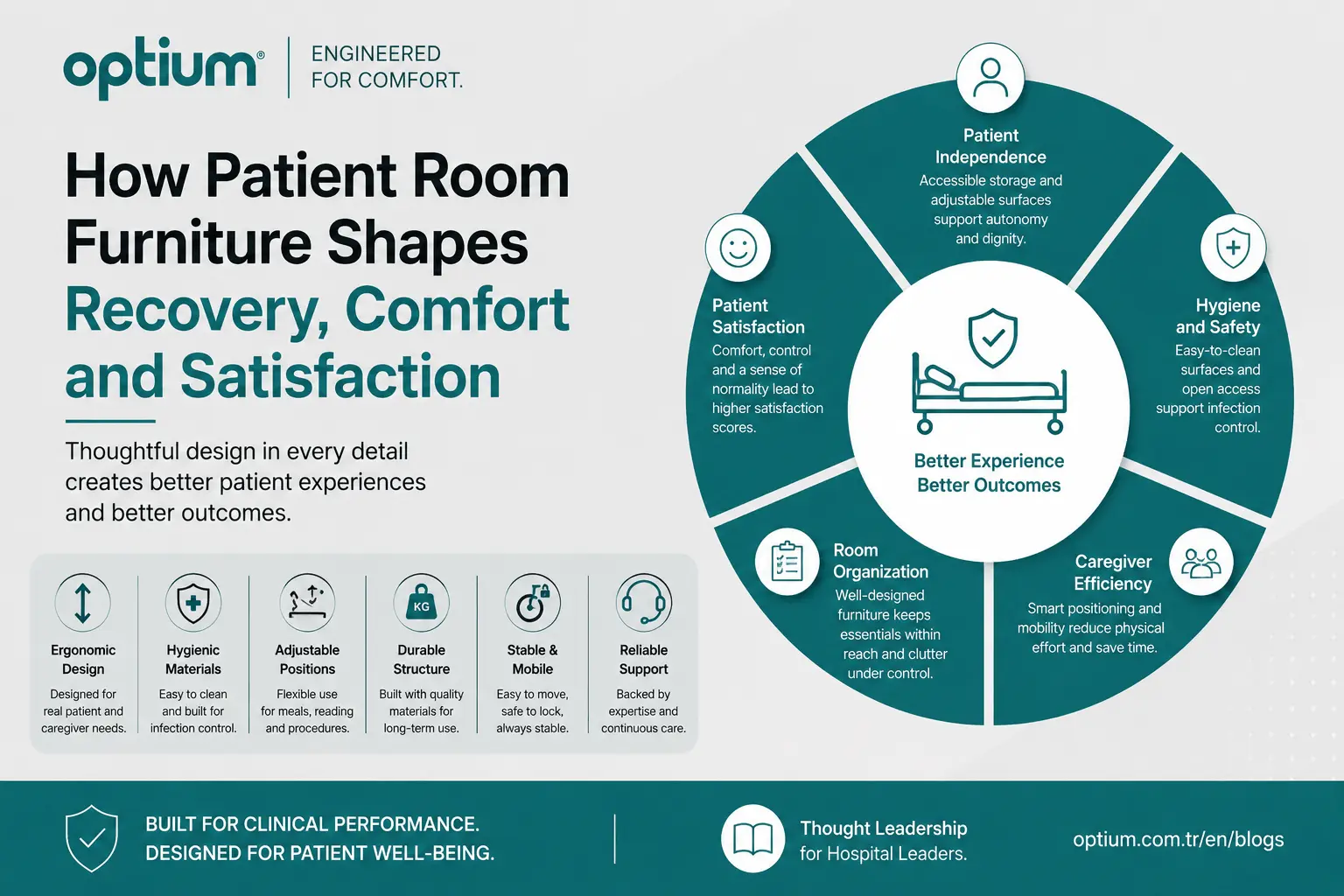
Patient room furniture can influence satisfaction through five practical factors:
Access to belongings: Patients can reach essential personal items without unnecessary assistance.
Autonomy and dignity: Accessible storage and adjustable surfaces return small but meaningful choices to the patient.
Caregiver efficiency: Suitable positioning reduces avoidable movement and disruption around the bed.
Room hygiene: Cleanable and accessible surfaces support routine and discharge cleaning.
Visual comfort: Coordinated furniture reduces clutter and reinforces a sense of order.
These factors do not operate independently. Together, they shape the environment in which patients receive care, interact with staff and evaluate their hospital experience.
Why Small Furniture Decisions Influence Patient Experience
Patients rarely judge a hospital room through one major event. Their impression develops through repeated bedside moments.
Can they reach their water? Is there a secure place for their glasses? Can they position the table for a meal? Do they need to call a nurse for an ordinary task they would normally complete independently?
A study by Lorissa MacAllister, Craig Zimring and Erica Ryherd examined 8,366 patient survey responses across 17 nursing units and 382 patient rooms. The researchers identified statistically significant relationships between patient room layout measures and survey questions concerning nursing care, physician care, individual care and the overall room environment.
A broader review of evidence based healthcare design research concluded that physical healthcare environments can contribute to safer and more supportive settings for patients and staff.
These findings do not prove that one cabinet or table determines recovery. They show that room design works as part of a wider care system.
Teams comparing furniture options for hospital patient rooms should therefore evaluate real patient and caregiver activities, not only dimensions, appearance and purchase price.
How Hospital Bedside Furniture Impacts Patient Satisfaction and Experience
Accessible Storage Supports Patient Independence
Patients commonly keep glasses, hearing aids, phones, water, tissues, books and documents beside the bed. Storage has little practical value when the patient cannot reach it safely.
Drawers, shelves and compartments should be accessible from realistic bed positions. Patients should not need to lean excessively, twist or repeatedly ask a caregiver to retrieve basic personal items.
Good storage design does more than reduce clutter. It helps patients maintain familiar routines and gives them control over the belongings that connect them to daily life outside the hospital.
Adjustable Surfaces Support Autonomy and Dignity
Hospitalisation inevitably reduces personal control. Patients must follow unfamiliar schedules, rely on staff and adapt to an environment designed primarily around clinical care.
An adjustable overbed table can return a small amount of independence. It provides a usable surface for meals, reading, writing, personal devices and communication with family members.
The most important question is not whether the room contains a table. It is whether the patient can position and use the table comfortably from the bed or chair.
Room Layout Affects Caregiver Efficiency
A patient room is both a healing environment and a workplace. Nurses, environmental services teams, technicians and support staff all need to move around the bed and access the patient safely.
A study involving 147 participants from 23 hospital occupational groups identified several recurring room design problems. These included inadequate space around the bed, the physical effort required to move furnishings and a lack of available horizontal surfaces.
A cabinet or table that repeatedly obstructs transfers, equipment positioning or cleaning creates friction during every shift.
Suitable furniture does not replace adequate staffing, but it can reduce avoidable movement and room preparation tasks.
Bedside Furniture Is a High Touch Surface
Bedside cabinets and overbed tables may be touched by patients, visitors, nurses, physicians, food service teams and cleaning staff.
The CDC identifies bedside tables as common high touch surfaces. Its environmental cleaning guidance also recommends that healthcare facilities identify high touch surfaces within each patient care area when developing cleaning procedures.
Procurement teams should therefore examine more than the headline material description.
They should inspect handles, corners, seams, shelves, castors, undersides and the space surrounding the unit. Furniture should also be movable when staff need to access the wall, floor or bed area during routine and discharge cleaning.
Visual Order Shapes the Perception of Care
Patients experience the bed, cabinet, overbed table, mattress, seating and circulation space as one complete environment. They do not separate these elements into different purchasing categories.
Worn, mismatched or cluttered furniture can weaken the impression of quality even when clinical care is excellent.
Coordinated furniture creates a more controlled and reassuring room without making the environment feel decorative or impractical.
Teams planning a complete room can review the wider Optium Room and Comfort range, including hospital mattresses and attendant seating solutions.
A Practical Three Zone Test for Bedside Furniture
For this article, Optium frames bedside furniture evaluation through a simple three zone test. The purpose is to prevent a product from solving one problem while creating another.
Patient reach zone: Can the patient reach the drawer, table surface, water and essential belongings from common bed positions?
Caregiver work zone: Can staff access the patient, operate side rails, position equipment and perform transfers without repeated obstruction?
Cleaning access zone: Can environmental services staff reach the top, sides, handles, castors, underside and surrounding floor?
A suitable product should support all three zones.
Optimising only the patient zone may obstruct caregivers. Prioritising only staff access may place belongings outside the patient’s reach. Furniture selection is strongest when all three perspectives are tested together.
Does Bedside Furniture Affect HCAHPS Scores?
A bedside cabinet is not a separate HCAHPS measure, so no furniture manufacturer can credibly promise a direct increase in HCAHPS scores.
The connection is indirect but relevant.
The official CMS HCAHPS survey covers areas including staff responsiveness, hospital cleanliness, the restfulness of the environment, the overall hospital rating and willingness to recommend the hospital.
Poorly positioned furniture may increase requests for basic assistance. Difficult surfaces may complicate cleaning. Unstable tables may create frustration. Inadequate storage may contribute to visible clutter.
Well selected furniture can support the conditions behind a better room experience, but it cannot control patient satisfaction independently of communication, staffing, clinical outcomes and care quality.
Optium Bedside Cabinet and Overbed Table Comparison
The following comparison presents six representative Optium bedside furniture configurations.
The most suitable option depends on the patient group, available room space, cleaning procedures and clinical workflow.
CB 16 Complete ABS Bedside Cabinet
Product type: Complete ABS bedside cabinet
Key features: Durable polymer structure, shock resistant ABS upper shelf, two drawers, internal compartments, a middle shelf, bottle holders, towel holders and four castors with two brakes.
Suitable for: Patient rooms requiring organised personal storage, raised containment edges and mobile positioning.
View the CB 16 Complete ABS Bedside Cabinet
CB 27 Metal Bedside Cabinet
Product type: Metal bedside cabinet
Key features: Metal construction, grade 304 stainless steel top, ventilation holes, a drawer, cupboard, adjustable shelf, raised edges and diagonally lockable castors.
Suitable for: Healthcare facilities evaluating metal construction, a stainless steel working surface and enclosed storage.
View the CB 27 Metal Bedside Cabinet
CB 12 Bedside Cabinet with HPL Top
Product type: Wooden bedside cabinet with an HPL top
Key features: Wooden construction, compact laminated HPL top, aluminium corners, a drawer, cupboard, internal shelf and diagonally lockable castors.
Suitable for: Patient rooms requiring a wood based cabinet with an HPL surface and enclosed personal storage.
View the CB 12 Bedside Cabinet with HPL Top
OB 33 Adjustable Overbed Table
Product type: Height adjustable and tiltable overbed table
Key features: HPL top surface, lateral tilting function, gas spring height adjustment, full swivel castors and lockable wheels.
Suitable for: Meals, reading, writing and personal device use from a hospital bed or patient chair.
View the OB 33 Adjustable Overbed Table
OCB 06 Bedside Cabinet with Integrated Overbed Table
Product type: Combined bedside cabinet and adjustable overbed table
Key features: Wooden body, aluminium corners, HPL surfaces, dual sided drawer and cupboard access, a foldable tilting table, gas spring adjustment, bottle holder and two lockable castors.
Suitable for: Patient rooms requiring accessible storage and an adjustable working surface within one mobile unit.
View the OCB 06 Bedside Cabinet with Integrated Overbed Table
OCB 36 Compact Combined Bedside Cabinet
Product type: Compact bedside cabinet with an integrated overbed table
Key features: Wooden construction, compact body, ABS top cover, a drawer, cupboard with an internal shelf, integrated ABS table and four castors with two brakes.
Suitable for: Compact patient rooms where personal storage and an integrated table must share a limited floor area.
View the OCB 36 Compact Combined Bedside Cabinet
These examples represent different approaches to storage, adjustability, mobility and space management.
Final selection should be based on bed compatibility, patient reach, caregiver access, cleaning requirements and available floor space.
What to Look for in Patient Room Furniture When Satisfaction Scores Matter
Test Reachability in Real Bed Positions
Evaluate the cabinet and table with the bed raised, lowered and articulated. Include patients or representative users with limited reach, grip strength or mobility.
Check Whether Operation Is Intuitive
Drawers, doors, brakes and adjustment mechanisms should be understandable without repeated explanation. Controls that confuse patients or staff add friction to routine use.
Review Stability and Mobility Together
Furniture should move efficiently when staff need to reposition it and remain stable when the patient is eating, reading or using personal devices.
Inspect the Complete Cleaning Path
Examine tops, corners, handles, shelves, undersides and wheels. Environmental services staff should confirm whether the complete unit and the surrounding floor can be accessed consistently.
Evaluate Compatibility With the Bed and Equipment
Bedside furniture should not obstruct bed articulation, side rail operation, transfers, clinical equipment, meal delivery or emergency access.
Room safety should also be considered as a connected system. Optium’s guide to patient falls and hospital bed design explains how bed setup, room layout and caregiver workflow interact.
Include Every Relevant User Group
Procurement, nursing, infection prevention, environmental services, facilities, healthcare designers and patient experience teams should all contribute before the final specification is approved.
Better Bedside Furniture Begins With a Better Procurement Question
The basic purchasing question is:
Which cabinet meets the specification at the lowest price?
The better question is:
Which configuration creates the fewest barriers for the patient, caregiver and cleaning team throughout its service life?
This shift turns bedside furniture from a commodity purchase into patient centred room planning.
It also encourages hospitals to consider service life, compatibility, maintenance and staff workflow alongside the initial purchase cost.
A similar lifecycle approach is discussed in Optium’s guide to hospital bed price and long term ownership value.
Conclusion
A bedside cabinet holds the belongings that connect patients to normal life. An overbed table supports meals, reading, communication and everyday independence.
These products are physically small, but they shape how the patient room functions throughout the day.
The strongest designs support access without clutter, mobility without instability, cleaning without unnecessary complexity and caregiver work without obstruction.
Optium offers a broad range of hospital bedside cabinets and overbed tables for different room layouts, material requirements and care environments.
Hospital administrators, ward managers, patient experience teams and healthcare designers can review the Optium medical equipment catalogue or contact Optium to compare configurations that support patient dignity, autonomy and a better room experience.
Frequently Asked Questions
Why Is a Hospital Bedside Cabinet Important?
A hospital bedside cabinet keeps essential belongings close to the patient. Suitable design can support independence, room organisation, cleaning access and caregiver workflow.
Can Hospital Furniture Improve Patient Recovery?
Furniture cannot guarantee faster recovery. It can support comfort, rest, personal control and efficient care within a wider healing environment.
Can a Bedside Cabinet Directly Improve HCAHPS Scores?
No. Bedside cabinets are not scored as a separate HCAHPS measure. They can support conditions related to patient access, room cleanliness, staff responsiveness and overall room experience.
What Makes an Overbed Table Patient Friendly?
It should be stable, adjustable, easy to position, easy to clean and usable from realistic bed and chair positions.
How Does Bedside Furniture Affect Hospital Hygiene?
Its surfaces, seams, handles, compartments, castors and mobility determine how easily staff can clean the unit and access the surrounding patient zone.
Who Should Participate in Furniture Selection?
Nursing, procurement, infection prevention, environmental services, facilities, healthcare designers and patient experience teams should all contribute.
Sources and Methodology
This article separates published evidence from design interpretation. It does not claim that a bedside cabinet independently improves recovery, clinical outcomes or HCAHPS scores.
Key sources:
Centers for Medicare and Medicaid Services: HCAHPS Patients’ Perspectives of Care Survey
Centers for Disease Control and Prevention: Environmental Cleaning Procedures
Lavender and colleagues: Hospital Patient Room Design and the Issues Facing 23 Occupational Groups
Ulrich and colleagues: A Review of the Research Literature on Evidence Based Healthcare Design