


A hospital stretcher is one of the most used pieces of equipment in clinical transport, yet it is often specified too late in the procurement process. It is not just a mobile surface for moving patients. It can affect emergency response, X-ray workflow, operating room transfer, ward movement, caregiver ergonomics, infection control routines and long-term maintenance cost.
For hospital procurement managers, department heads, biomedical engineers and facility planners, the right question is not “Which stretcher looks strongest?” The better question is: “Which stretcher fits the department where it will be used?”
A stretcher for an emergency department should not be evaluated the same way as a stretcher for routine ward transport. A trauma stretcher should not be specified like an operating room transfer stretcher. A patient transport stretcher used across corridors, elevators and imaging routes needs a different balance of safety, mobility, comfort and durability.
For buyers comparing Optium hospital stretcher models, the safest approach is to start with the patient journey: where the patient comes from, where the patient needs to go, how often transfers happen and which departments depend on the stretcher during care.
What makes a good hospital stretcher?
A good hospital stretcher is stable, maneuverable, easy to clean, safe during transfer and matched to the department where it will be used.
In practical terms, a stretcher should help staff do four things well:
Move patients safely between departments
Position patients with less manual strain
Protect patients during transport and handoff
Support the workflow of the department using it
This is why generic buying guides can be incomplete. They may list side rails, wheels, brakes and mattress comfort, but they often miss the operational question: does this stretcher reduce friction in the actual patient pathway?
The best stretcher is not always the most advanced model. It is the model that fits the department’s movement, safety and diagnostic needs.
Start with department use case before comparing features
Hospitals often buy stretchers as a shared transport category, but each department uses them differently.
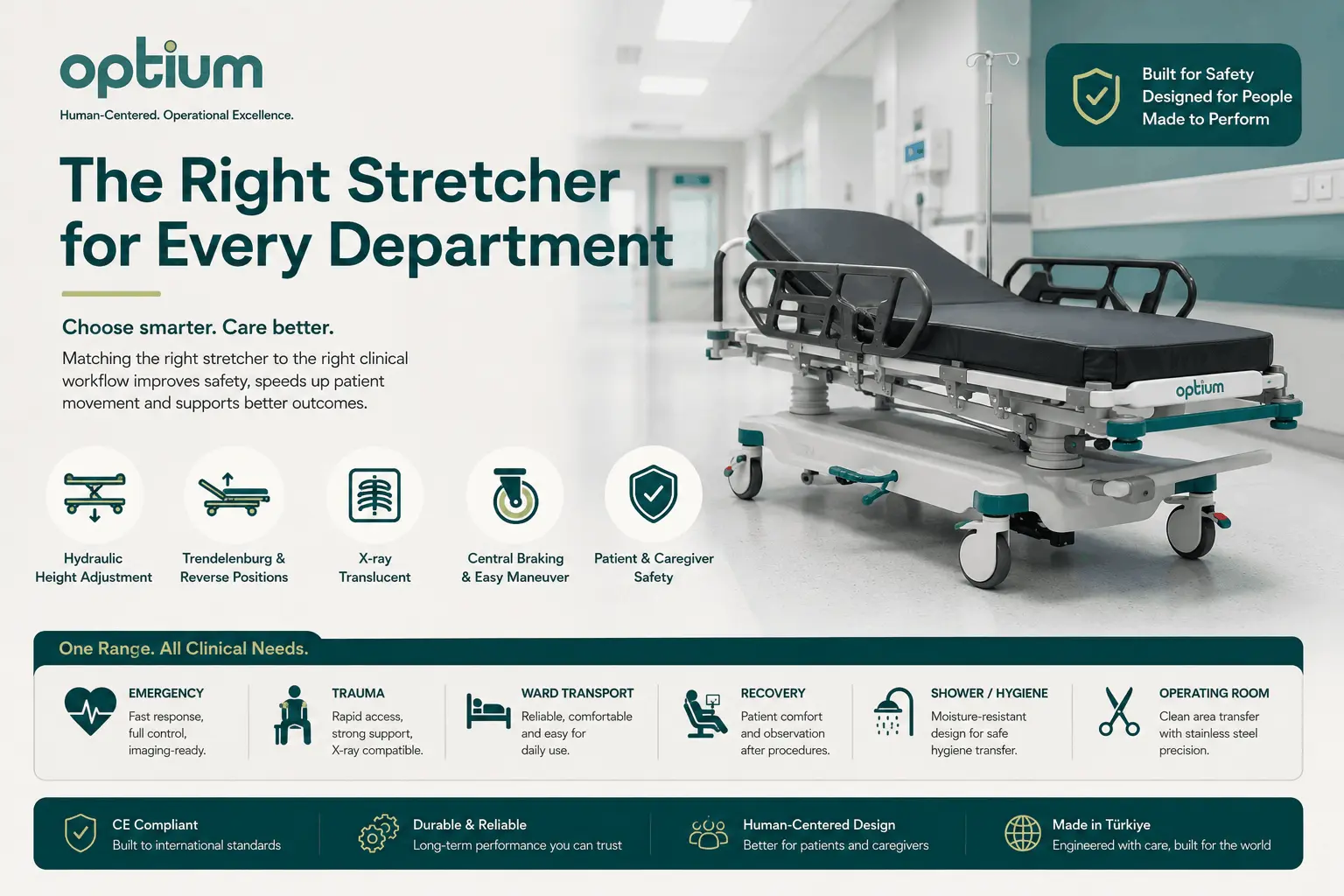
Emergency departments need speed, braking control, positioning and imaging readiness. Trauma areas need full patient access, X-ray workflow support and reliable maneuverability. General wards need dependable daily patient movement. Recovery areas need comfort and observation access. Shower or hygiene transfer areas need cleaning-friendly design. Operating rooms need controlled transfer between clean and non-clean areas.
This department-based thinking prevents two common procurement mistakes.
First, it avoids under-specifying critical departments. An ER stretcher without imaging support can slow diagnostic workflow. A trauma stretcher with poor side access can make urgent care harder.
Second, it avoids over-specifying routine areas. Not every ward transport route needs a trauma-level stretcher. Sometimes a simpler hydraulic patient transport stretcher is the better long-term value.
Before selecting a model, define the primary use case:
ER and acute care transport
Trauma and imaging support
Routine ward and department transfer
Recovery and observation
Shower or hygiene-related transfer
Operating room clean-area transfer
Multi-department patient movement
The full Optium clinical transport stretcher range gives procurement teams a useful starting point because it separates emergency, trauma, recovery, shower, patient transport and operating room transfer needs instead of treating every stretcher as the same product.
How to choose a hospital stretcher for emergency department buyers
Emergency departments need stretchers that help teams move quickly without losing control. In the ER, the stretcher may go from triage to treatment, from treatment to imaging, from imaging back to observation and then to admission, transfer or discharge.
Every unnecessary lift, delay or repositioning step matters.
For emergency department buyers, the priority should be a stretcher that supports fast positioning, stable movement, imaging workflow and safe bedside access. The stretcher should feel like part of the emergency workflow, not an obstacle inside it.
What ER teams should prioritize
ER procurement should focus on:
Hydraulic height adjustment
Fast backrest positioning
Trendelenburg and reverse Trendelenburg where clinically required
Central braking and steer control
Reliable side rails
Protective bumpers
Oxygen holder and IV pole
X-ray translucent platform or cassette access
Easy-clean mattress and surfaces
The Emergeum Functional Emergency Stretcher is the strongest Optium starting point for emergency departments. Its product data highlights hydraulic height adjustment, two-section mattress surface, Trendelenburg and reverse Trendelenburg positions, gas spring-assisted backrest adjustment, an X-ray translucent mattress platform, sliding X-ray cassette holder, 10 cm foam mattress, 12-liter oxygen tank holder, swing-away side rails, central braking, 200 mm castors and a fifth wheel for easier maneuverability.
Are ER stretchers slowing down imaging?
They can be.
If an emergency stretcher does not support imaging workflow, staff may need to transfer the patient to another surface or spend extra time positioning the cassette. That slows the pathway between emergency care and diagnosis.
A stretcher with X-ray translucent design or cassette holder support can reduce handling steps and make the ER-to-radiology process smoother. This does not replace imaging equipment or clinical protocols, but it can remove a practical bottleneck from the transport chain.
Trauma and imaging stretchers need faster access, not just stronger frames
Trauma environments create a different kind of pressure. Teams may need rapid access from multiple sides, fast positioning, imaging compatibility and strong braking control in a high-intensity setting.
A trauma stretcher should support treatment and diagnostics at the same time. If it slows imaging or makes side access difficult, it can create friction during the moments when speed matters most.
The Momentum Functional Trauma Stretcher is designed for this workflow. Its product data includes hydraulic height adjustment, a three-section mattress surface, Trendelenburg and reverse Trendelenburg positions, gas spring-assisted backrest and legrest adjustment, an 8 cm mattress, a full-length dual-deck HPL X-ray translucent mattress platform, 12-liter oxygen tank holder, foldable lockable side rails, 200 mm castors, central braking and steer control.
What to check before buying for trauma
Procurement teams should verify:
Whether imaging is needed on the stretcher surface
Whether the X-ray translucent area covers the required imaging zones
How side rails fold or store during access
Whether the stretcher supports fast movement through corridors
Whether accessories such as a monitor shelf or safety belt are needed
Whether braking and steering are easy to control under pressure
For trauma and imaging-heavy departments, the stretcher should reduce patient handling rather than create another transfer step.
Ward transport stretchers should be reliable, simple and easy to live with
Routine patient transport is less dramatic than emergency care, but it happens constantly. A ward stretcher may move patients between rooms, departments, imaging, recovery and discharge areas many times a day.
For general transport, the best stretcher is usually the one staff can use confidently without unnecessary complexity.
A good patient transport stretcher should be:
Easy to steer
Stable during movement
Comfortable for short transport periods
Simple to clean
Practical to maintain
Safe during patient transfer
Durable under repeated daily use
The ST 62 Hydraulic Patient Stretcher is a practical fit for routine transport needs. Its product information includes hydraulic height adjustment by dual-sided pedals, manual backrest adjustment by gas spring, synthetic leather-coated mattress, steel sheet mattress platform, full-length lockable safety side rails, undercarriage storage, IV pole, protective bumpers and optional features such as an X-ray translucent HPL mattress platform, central locking mechanism, oxygen holder and patient safety belt.
This is the kind of model procurement teams should consider when they need durable transport capacity without specifying an emergency or trauma stretcher for every area.
Recovery stretchers: comfort and observation after procedures
Recovery areas have a different priority profile. The patient may need observation, comfort, positioning flexibility and safe movement between clinical zones.
A recovery stretcher should support staff visibility and patient comfort while still remaining practical for cleaning, braking and transport. It should not feel like a trauma stretcher repurposed for recovery. The workflow is different.
The Epsilon Functional Recovery Stretcher is relevant where recovery and observation are part of the patient pathway. Its product data highlights hydraulic height adjustment, a seven-section mattress surface, Trendelenburg and reverse Trendelenburg positions, gas spring-assisted backrest adjustment, a 10 cm foam mattress, X-ray translucent mattress platform, oxygen holder, detachable and lockable PP side rails, central braking, 200 mm castors and a fifth wheel for maneuverability.
When recovery-specific stretchers make sense
Consider a recovery-focused stretcher when the department needs:
More positioning flexibility than routine transport
Comfortable short-term patient observation
Stable braking and easy maneuvering
Easy-clean surfaces between cases
Accessory options such as safety belt or monitor shelf
A design that supports post-procedure workflow
For procurement teams, adding recovery to the stretcher plan prevents the common mistake of using one transport model for every patient movement scenario.
Shower and hygiene transfer stretchers should not be treated as standard transport
Shower and hygiene-related transfer is a specialized use case. These stretchers need to support patient washing, assisted hygiene, moisture exposure and safe movement in environments where cleaning and drainage logic matter.
This is not the same as corridor transport.
Buyers should ask whether the stretcher is intended for shower or hygiene workflows, how surfaces handle moisture, how side rails support patient safety and how the product is cleaned after use.
The ST 610 Hydraulic Shower Stretcher is the Optium model to review for this use case. Its product data includes nano ceramic-coated electrostatic powder-painted metal parts, a one-section HPL lying surface, easy foldable metal side rails, custom liquid-proof pool mattress, Trendelenburg by gas spring, 150 mm 360-degree turning castors with central and directional lock, hydraulic height adjustment and bumpers on four corners.
What to verify for shower transport
For shower and hygiene-related stretchers, procurement teams should confirm:
Moisture-resistant surface details
Mattress design and liquid-proof properties
Side rail safety during assisted hygiene
Castor lock and directional control
Cleaning compatibility
Drainage or hygiene workflow requirements
Safe working load on the technical sheet
A shower stretcher should be selected as a hygiene workflow product, not as a modified general transport stretcher.
Operating room transfer stretchers need clean-area logic
Operating room transfer is not just patient movement. It is a controlled workflow between areas with different hygiene requirements.
An OR transfer stretcher should support safe patient movement while respecting the hospital’s clean and non-clean zone logic. In this setting, the question is not only whether the stretcher rolls smoothly. The question is whether the stretcher supports the transfer process itself.
The OT TRANS Operating Room Transfer Stretcher is the model to review for surgical transfer workflows. Its product data highlights two combinable and lockable 304-quality stainless steel chassis and one sliding stainless steel stretcher. One chassis is designed for the dirty area and the other for the clean area, supporting patient transfer from the dirty area to the clean area of the operating room.
This two-chassis logic is the key differentiator. It makes OT TRANS more than a transport trolley; it is a transfer workflow system for controlled surgical environments.
Why stainless steel matters in OR transfer
Stainless steel can be valuable in operating room transfer because of cleaning intensity, corrosion resistance and long-term durability expectations. OT TRANS also includes gas spring-assisted backrest adjustment, 304-quality stainless steel main structure, a viscoelastic mattress, full-length polyurethane side rails with safety lock mechanism, compact laminate mattress platform, IV pole sockets, drainage bag holders, accessory hooks, pushing bars and 360-degree swivel lockable castors.
Stainless steel is not automatically required for every stretcher in the hospital, but it becomes more relevant where hygiene routines and controlled transfer are central to the workflow.
For facility planners, OR transfer should be specified as a process tool, not just a transport trolley.
Hydraulic vs electric adjustment: choose by workflow, not by buzzword
Adjustment mechanism affects ergonomics, maintenance and daily usability.
Hydraulic adjustment is widely used in hospital stretchers because it gives staff fast height control without depending on charging or power availability. Foot pedal operation can be especially practical in emergency, trauma and transport environments where hands may already be occupied.
Electric adjustment can be valuable in some medical equipment categories, but it is not automatically better for every stretcher. In many transport workflows, hydraulic systems offer the right balance of speed, reliability and serviceability.
When hydraulic is often practical
Hydraulic stretchers often make sense when the department needs:
Frequent height changes
Foot-operated adjustment
Movement between departments
Simple operation during urgent care
Lower dependence on electrical systems
Practical maintenance routines
Biomedical engineers should review:
Adjustment smoothness
Pedal access from both sides
Service requirements
Replacement part availability
Stability at different height positions
Compatibility with hospital maintenance routines
X-ray compatibility: the hidden factor in ER and trauma throughput
X-ray compatibility is one of the most important criteria for emergency and trauma stretcher procurement.
If patients must be repeatedly moved from stretcher to imaging surface, staff effort increases and the diagnostic pathway can slow down. This is especially important in emergency departments, trauma rooms and acute care routes where imaging decisions can drive the next step of care.
A stretcher may be described as imaging-compatible, but buyers should ask more specific questions.
Check:
Is the mattress platform X-ray translucent?
Is there a cassette holder?
Does the cassette slide under the full platform or only part of it?
Does the stretcher support the imaging workflow used in the department?
Are optional imaging features included in the quoted configuration?
This is where model-level verification matters. Emergeum includes an X-ray translucent platform and a sliding cassette holder. Momentum includes a full-length dual-deck HPL X-ray translucent mattress platform. ST 62 offers an X-ray translucent HPL mattress platform as an option. Epsilon also lists an X-ray translucent mattress platform. Procurement teams should confirm the exact configuration before ordering.
Side rail systems should balance patient safety with fast access
Side rails are not only safety barriers. They affect transfers, access, cleaning and staff movement around the patient.
A good side rail system should be secure when raised and easy to operate when access is needed. In emergency and trauma settings, side rails should not slow the team down. In routine transport, they should give patients confidence and reduce fall risk during movement.
Buyers should evaluate:
Full-length vs partial rail design
Locking mechanism
Fold-away or swing-away movement
Transfer gap when rails are lowered
Cleanability around hinges
Durability under repeated use
Ease of use for staff wearing gloves
This is where different Optium models serve different needs. Emergeum uses swing-away collapsible side rails. Momentum uses full-length foldable and lockable side rails that store under the mattress. Epsilon uses detachable and lockable PP side rails. ST 610 uses easy foldable metal side rails for hygiene-related workflows. The best choice depends on department workflow.
Load capacity and structural reliability protect long-term value
Load capacity should never be treated as a minor line in a technical sheet.
Hospitals serve patients with different body types and mobility levels. The stretcher must remain stable during movement, braking, transfer, adjustment and positioning. Frame quality, castor design, mattress platform strength and brake reliability all affect structural performance.
Before approving a hospital stretcher, buyers should ask:
What is the safe working load?
Is the rating valid across all positions?
How does the frame perform under repeated daily use?
Are the castors suitable for hospital corridors and elevators?
How easy is the stretcher to brake and steer under load?
What maintenance is required to preserve performance?
If safe working load, dimensions or warranty data are not visible on a product page, procurement teams should request the model-specific technical sheet before approval. These numbers should not be guessed or assumed from the product category.
Stainless steel vs powder-coated frame: match material to department risk
Frame material affects cleaning, durability, appearance and cost.
Electrostatic powder-coated steel frames can be practical for emergency, trauma and general transport stretchers because they balance strength, finish and cost. Stainless steel is often more relevant in operating room transfer, clean-area workflows and environments with intensive cleaning demands.
When powder-coated frames can make sense
Powder-coated construction may be suitable for:
Emergency departments
General patient transport
Trauma areas
Daily hospital movement
Budget-sensitive projects
When stainless steel becomes more important
Stainless steel may be more appropriate for:
Operating room transfer
Clean-zone workflows
High cleaning frequency
Corrosion-resistance needs
Long service-life expectations
The goal is not to choose the most expensive material everywhere. The goal is to match the material to the department’s cleaning routine, durability need and clinical risk.
CE documentation and IEC standards: what procurement should request
For international hospital procurement, documentation is part of the product.
Where applicable, CE marking and conformity assessment should be reviewed against the target market’s requirements. Under the EU Medical Device Regulation, medical devices are regulated through MDR 2017/745, and Notified Bodies are designated to assess conformity for certain product categories before market placement when third-party involvement is required. Buyers can review the European Commission’s information on Notified Bodies for medical devices and the official EU Medical Device Regulation text for regulatory context.
For products with electrical components, buyers may also request relevant IEC references. IEC 60601-1 addresses basic safety and essential performance for medical electrical equipment.
However, buyers should not rely on generic claims. They should ask for documentation connected to the exact model and configuration being purchased.
Request:
Declaration of Conformity where applicable
CE documentation if required by the market or tender
Applicable IEC references for electrical components, if present
User manual
Maintenance instructions
Spare parts list
Warranty terms
Technical data sheet
Cleaning and disinfection guidance where available
This gives biomedical engineers and procurement teams a clearer basis for approval.
Total cost of ownership: the number that matters after purchase
The cheapest stretcher on paper can become expensive in operation.
A stretcher creates cost through maintenance, downtime, mattress replacement, castor wear, brake repair, cleaning time, spare parts delays, difficult maneuvering and poor department fit. These costs may not appear in the first quotation, but they show up in daily hospital operations.
The WHO technical specification user guide for medical devices highlights the importance of reviewing accessories, consumables, spare parts, warranty, maintenance and training information when planning medical equipment use. That same logic applies directly to stretcher procurement.
A better total cost of ownership review includes:
Initial purchase price
Expected service life
Maintenance requirements
Spare parts availability
Mattress replacement cost
Castor and brake durability
Ease of cleaning
Staff handling effort
Downtime risk
Supplier responsiveness
Repeat-order consistency
A stretcher that supports workflow, remains serviceable and reduces handling friction can deliver stronger value than a cheaper model that creates recurring operational problems.
Optium stretcher model comparison by department
Use this section as a procurement starting point when comparing Optium stretcher models. It is not a substitute for technical approval. Biomedical teams should still request model-specific datasheets before final selection.
Emergeum: emergency department and acute care
Emergeum is the strongest starting point for emergency departments and acute care routes where fast positioning, X-ray workflow and controlled movement matter.
Its X-ray workflow support includes an X-ray translucent platform and sliding X-ray cassette holder. Notable verified details include a 10 cm mattress, 12-liter oxygen tank holder, 200 mm castors, fifth wheel and central braking. Its swing-away collapsible side rails support fast emergency access.
For load capacity and final configuration, procurement teams should verify the model-specific technical sheet.
Momentum: trauma and imaging-heavy workflows
Momentum is the more relevant option for trauma departments and imaging-heavy patient pathways where access, positioning and X-ray workflow are central to care.
Its product data includes a full-length dual-deck HPL X-ray translucent mattress platform. Notable verified details include an 8 cm mattress, 12-liter oxygen tank holder, 200 mm castors and optional 125 mm fifth wheel. Its full-length foldable lockable side rails support trauma access and patient transfer.
For load capacity and final configuration, procurement teams should verify the model-specific technical sheet.
ST 62: general ward and patient transport
ST 62 is a practical option for general ward movement and routine patient transport where reliability, comfort and daily usability matter more than trauma-level specialization.
Its X-ray translucent HPL platform is listed as an optional feature. Notable details include dual-sided hydraulic pedals, undercarriage storage, optional oxygen holder and optional central locking. Its full-length lockable safety side rails support routine patient transport.
For load capacity and final configuration, procurement teams should verify the model-specific technical sheet.
Epsilon: recovery and observation
Epsilon is relevant for recovery and observation areas where comfort, positioning and post-procedure monitoring are important.
Its product data lists an X-ray translucent mattress platform. Notable verified details include a seven-section mattress surface, 10 cm mattress, 200 mm castors, fifth wheel and central braking. Its detachable and lockable PP side rails support recovery workflow and patient safety.
For load capacity and final configuration, procurement teams should verify the model-specific technical sheet.
ST 610: shower and hygiene-related transfer
ST 610 is designed for shower and hygiene-related patient transfer rather than general corridor transport or primary imaging use.
Notable verified details include a liquid-proof pool mattress, 150 mm castors, HPL lying surface and hydraulic height adjustment. Its easy foldable metal side rails are relevant for hygiene-related workflows. Its nano ceramic-coated electrostatic powder-painted metal parts also make it a model to review where moisture and cleaning routines are central to the use case.
For load capacity, drainage logic and final configuration, procurement teams should verify the model-specific technical sheet.
OT TRANS: operating room transfer
OT TRANS is the relevant model for operating room transfer and clean-area workflow.
Its strongest differentiator is the two lockable 304 stainless steel chassis system for clean and dirty areas, plus a sliding stainless steel stretcher. This supports controlled transfer from the dirty area to the clean area of the operating room. OT TRANS also includes full-length polyurethane side rails with a safety lock mechanism and a 304-quality stainless steel transfer workflow.
For load capacity and final configuration, procurement teams should verify the model-specific technical sheet.
Hospital Stretcher Procurement Checklist by Department
Use this checklist before shortlisting a model.
Emergency department
Choose a stretcher with fast positioning, controlled mobility and imaging support.
Check for:
Hydraulic height adjustment
Gas spring-assisted backrest
Trendelenburg and reverse Trendelenburg
Central braking and steer control
X-ray translucent platform
Cassette holder
Oxygen holder
IV pole
Shock protection
Swing-away or collapsible side rails
Recommended Optium starting point: Emergeum emergency stretcher
Trauma and imaging routes
Choose a stretcher that supports access, positioning and radiology workflow.
Check for:
Multi-section mattress surface
X-ray translucent platform
Full-length foldable side rails
Strong maneuverability
Central braking
Oxygen holder
IV pole
Optional monitor shelf or safety belt
Easy-clean surfaces
Recommended Optium starting point: Momentum trauma stretcher
General ward and patient transport
Choose a stretcher that is durable, comfortable and easy to use every day.
Check for:
Hydraulic height adjustment
Backrest adjustment
Full-length side rails
Comfortable mattress
Protective bumpers
IV pole
Undercarriage storage
Optional central locking
Optional oxygen holder
Practical maintenance
Recommended Optium starting point: ST 62 hydraulic patient stretcher
Recovery and observation
Choose a stretcher that supports comfort, positioning and observation after procedures.
Check for:
Multi-section surface
Backrest adjustment
Stable braking
Comfortable mattress
Easy-clean materials
Side rail safety
Oxygen holder
Monitor shelf or safety belt if needed
Recommended Optium starting point: Epsilon recovery stretcher
Shower and hygiene-related transfer
Choose a stretcher specifically intended for hygiene workflows.
Check for:
Moisture-resistant surfaces
Cleaning compatibility
Safe side rail design
HPL lying surface
Liquid-proof mattress
Stable castors and brakes
Patient comfort during washing or assisted hygiene
Technical sheet confirmation before purchase
Recommended Optium starting point: ST 610 hydraulic shower stretcher
Operating room transfer
Choose a stretcher designed around clean-area transfer, not just movement.
Check for:
Stainless steel structure
Clean and dirty area transfer logic
Sliding transfer system
Lockable chassis
Cleanable mattress platform
Secure side rails
Accessory sockets
Lockable castors
Controlled patient transfer
Recommended Optium starting point: OT TRANS operating room transfer stretcher
FAQ
What is the most important factor when choosing a hospital stretcher?
The most important factor is department fit. A hospital stretcher should match the workflow of the emergency department, trauma area, ward, imaging route, recovery area, hygiene transfer area or operating room transfer process where it will be used.
What is the difference between a hospital stretcher and a patient transport stretcher?
A hospital stretcher is a broad term for clinical transport equipment used across hospital departments. A patient transport stretcher usually refers to a stretcher used for routine movement between wards, rooms, imaging departments or recovery areas.
How do you choose a hospital stretcher for emergency department use?
To choose a hospital stretcher for emergency department use, prioritize hydraulic height adjustment, fast backrest positioning, reliable side rails, central braking, maneuverability, oxygen holder, IV pole and X-ray compatibility where imaging workflow matters.
Why does X-ray compatibility matter in emergency and trauma stretchers?
X-ray compatibility can reduce unnecessary patient transfers and support faster diagnostic workflow. In emergency and trauma settings, a stretcher with an X-ray translucent platform or cassette holder can help reduce friction between treatment and imaging.
Should hospitals choose hydraulic or electric stretchers?
Hydraulic stretchers are often practical for emergency, trauma and transport use because they support fast height adjustment without dependence on charging or power access. Electric features may be relevant in some equipment types, but the right choice depends on workflow, maintenance and department preference.
What should biomedical engineers check before approving a stretcher?
Biomedical engineers should check safe working load, frame construction, castors, brakes, side rail mechanism, height adjustment system, spare parts availability, maintenance requirements, CE documentation where applicable and IEC references for electrical components if present.
Which Optium stretcher should procurement teams compare first?
Procurement teams should start with the department use case. Emergeum is relevant for emergency departments, Momentum for trauma and imaging workflows, ST 62 for routine patient transport, Epsilon for recovery areas, ST 610 for hygiene-related transfer and OT TRANS for operating room transfer.
Final CTA
Choosing the right hospital stretcher is a department-by-department decision. Emergency teams need speed and imaging support. Trauma teams need access and positioning. Ward teams need reliable daily transport. Recovery areas need patient comfort and observation support. Shower and hygiene transfer areas need cleaning-friendly design. Operating rooms need controlled transfer and clean-area logic. Biomedical teams need serviceability, documentation and lifecycle confidence.
Optium offers a stretcher range that helps procurement teams match the right model to the right clinical workflow.
Explore the Optium hospital stretcher range to compare Emergeum, Momentum, ST 62, Epsilon, ST 610, OT TRANS and other clinical transport models for emergency, trauma, ward, imaging, recovery, hygiene and operating room needs.